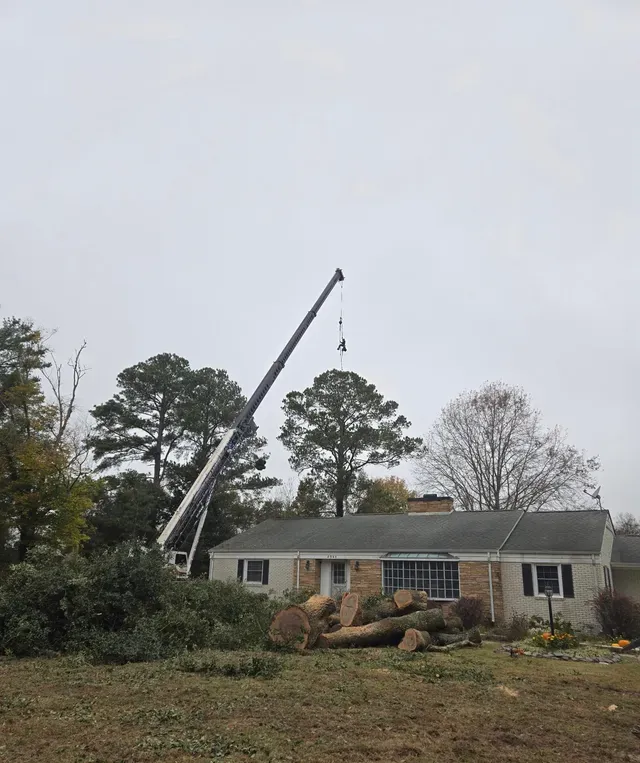
What Tree Removal Actually Involves
Cutting down a tree isn’t the hard part. Getting it on the ground safely - without hitting your house, your fence, your neighbor’s car, or the power line running through the canopy - that’s the job.
We remove trees of every size across Nash, Wayne, Wilson, Edgecombe, Halifax, Greene, Lenoir, Johnston, and Pitt counties. From a 20-foot ornamental blocking your driveway to an 80-foot oak leaning over your roof, the approach changes but the standard doesn’t. Every job gets a plan, proper equipment, and a clean yard when we leave.
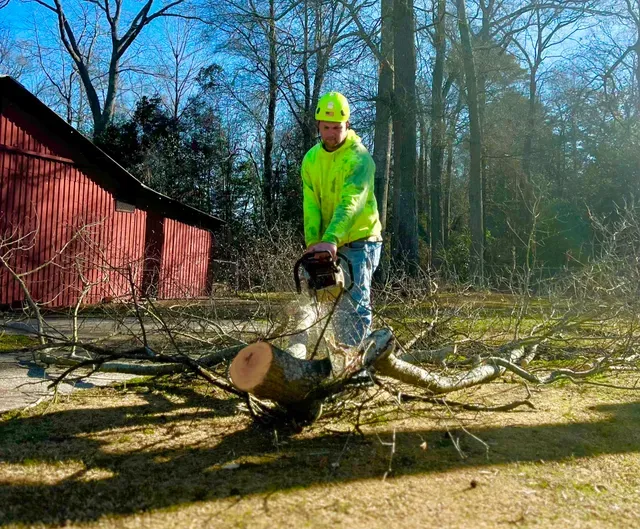
Our Process: How We Take Down a Tree
1. On-Site Assessment
We walk the property and look at the tree before quoting anything. We’re checking:
- Species and condition. A dead pine and a live white oak are completely different jobs. Dead wood is unpredictable - branches snap, trunks split. Hardwoods are heavier per foot than softwoods.
- Lean and weight distribution. Where does the tree want to fall? Where do we need it to fall? Those are often two different directions.
- Surroundings. Structures, fences, other trees, power lines, septic lines, driveways. Anything that can be damaged determines how we approach the removal.
- Access. Can we get equipment in? Is the yard soft? Is there a gate we need to fit through? Access affects time, and time affects cost.
2. Rigging Plan
Every tree gets a plan. For open-area trees, that plan might be simple: establish a drop zone, make the cuts, lay it down. For trees near structures or in tight spaces, the plan involves ropes, rigging hardware, and controlled lowering of each piece.
We decide at this stage whether the tree is a:
- Straight fell - open space, predictable lean, cut and drop.
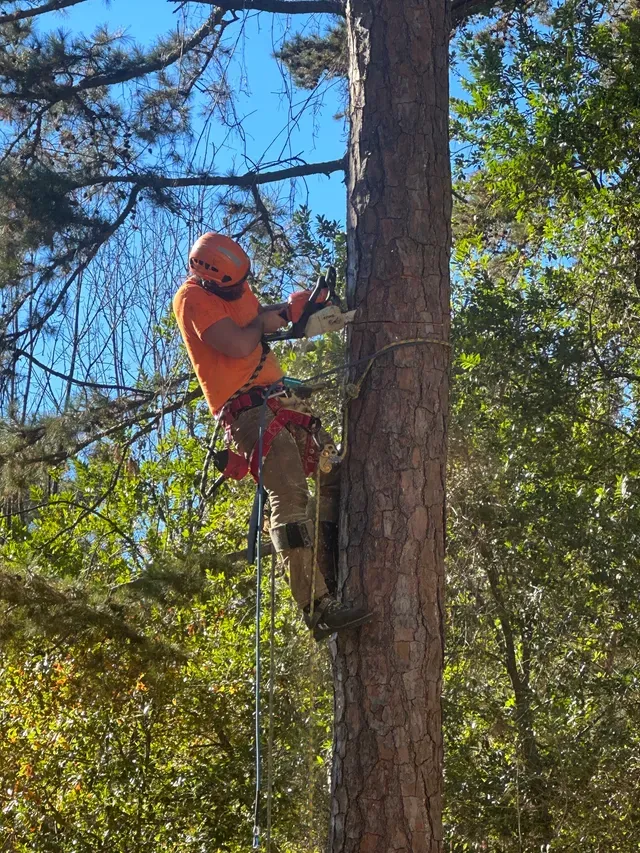
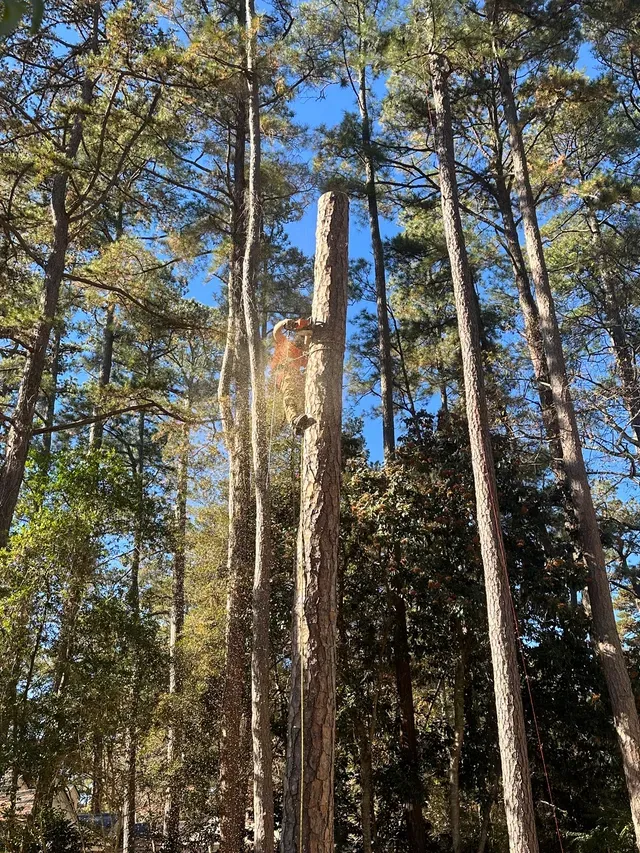
- Sectional removal - climber works from the top down, cutting manageable sections that are either free-dropped into a clear zone or lowered on ropes.
- Crane removal - the tree is too large, too close to a structure, or in a spot where rigging from the tree itself isn’t safe or practical.
3. Execution
Depending on the plan, our climber goes up or the crane comes in. Sections come off the top first, working down. Ground crew processes everything as it comes down - cutting logs to manageable lengths, feeding brush into the chipper, keeping the work area organized.
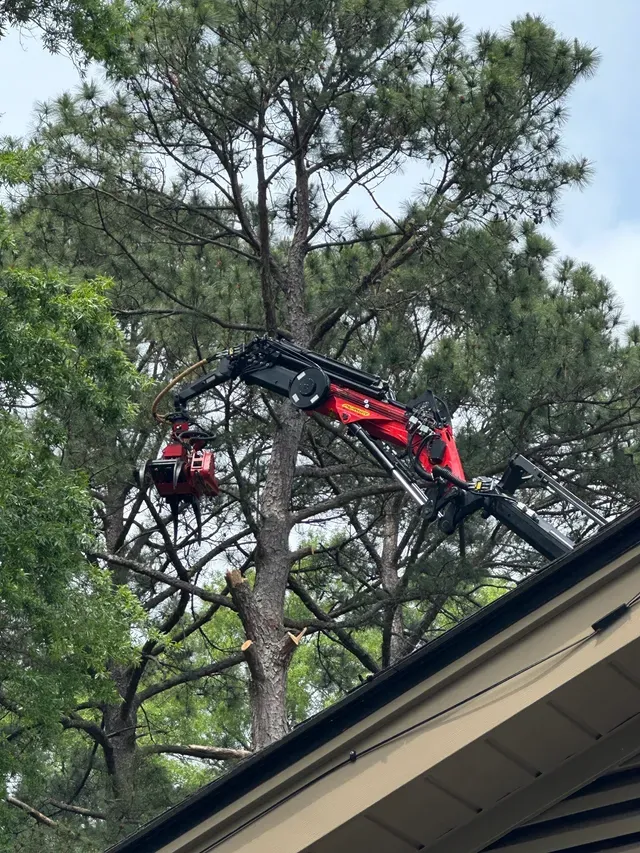
For crane removals, we subcontract Stewart’s Crane out of Wendell. The crane operator picks sections while our climber makes the cuts. It’s faster than climbing for big trees and eliminates most of the risk of dropping wood near structures. A crane can lift a 5,000-pound section straight up and set it down in the street. Try doing that with ropes.
4. Cleanup
Cleanup is not an add-on. It’s part of the job. We chip brush, haul logs, rake the area, and blow off your driveway. When we pull out, the only evidence we were there is the missing tree and a stump.
Types of Tree Removal We Handle
Single Tree Removal
The most common call. One tree that’s dead, dying, too close to the house, or just in the way. Most residential single-tree jobs in Rocky Mount, Goldsboro, Wilson, and surrounding areas run $500-$1,500 and take a few hours.
Multi-Tree Removal
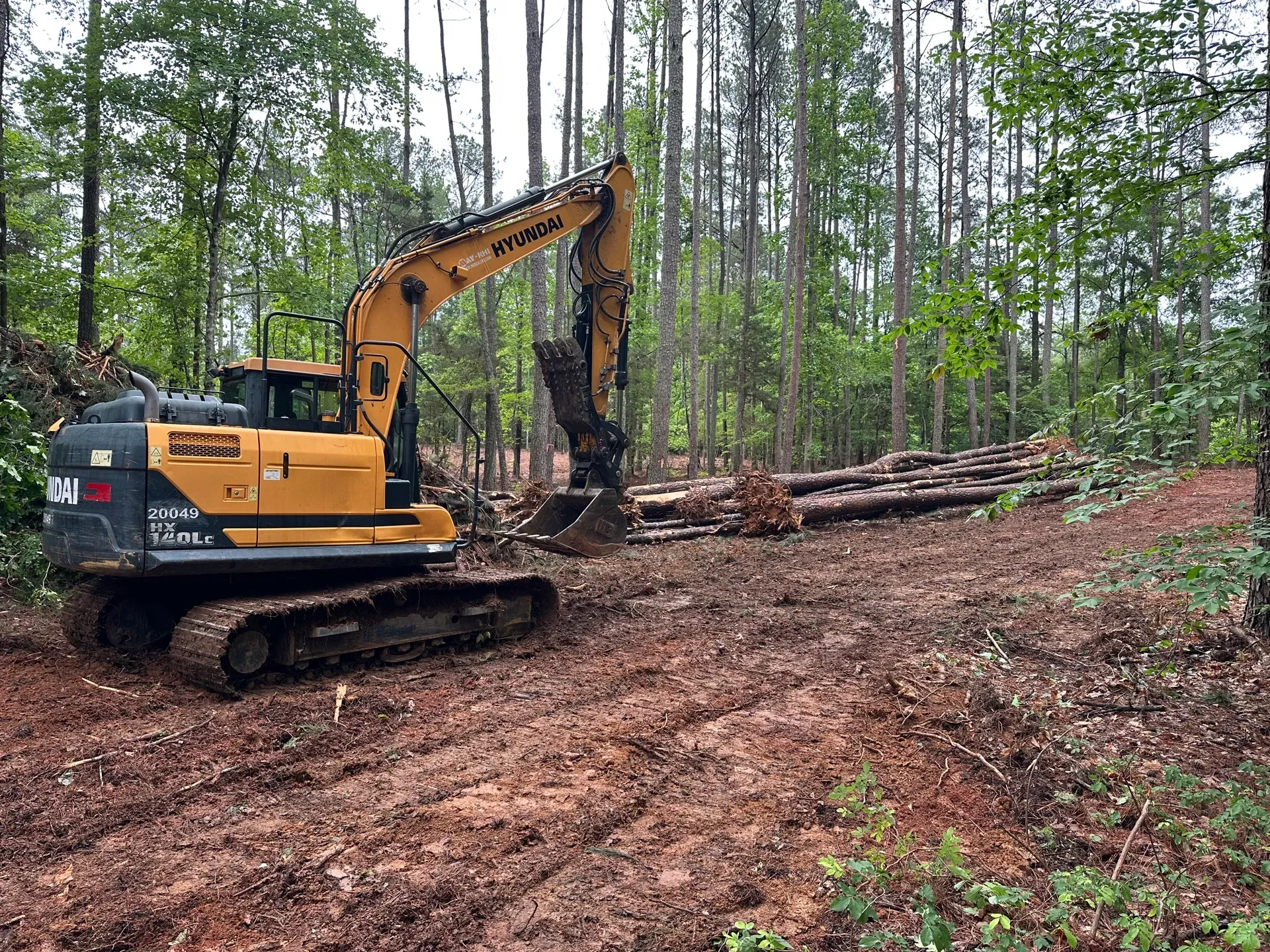
Clearing several trees from a lot is more efficient per tree than one-offs. If you’ve got 5-10 trees that need to come down, we can usually do it in a day and the per-tree cost drops. This is common for property owners prepping for construction, clearing a backyard, or dealing with a stand of dead pines.
Hazardous and Leaning Trees
Trees that are actively failing - split trunks, major lean toward a structure, root heave, large dead limbs hanging in the canopy. These need to come down before they come down on their own. Hazardous removals often require more rigging because the tree’s structural integrity is compromised. You can’t trust a dead trunk to hold a climber’s weight the same way you trust a live one.
Trees Near Structures
The roof of your house is not a drop zone. When a tree is growing against or over a structure, every piece comes off controlled. Ropes, pulleys, and a ground crew managing each lowered section. It’s slower and costs more, but that’s the only way to do it without putting the structure at risk.
Trees Near Power Lines
We do not work on trees actively contacting power lines - that’s the power company’s responsibility. But we remove trees that are near lines, growing toward lines, or at risk of falling into lines. Depending on proximity, we may coordinate with the utility for a temporary disconnect before we start.
Crane-Assisted Removal
When a tree is too large to rig from itself safely, or when it’s sitting directly over a house and there’s no room for error, the crane comes in. Common scenarios:
- 80+ foot hardwoods in residential yards
- Trees completely enclosed by structures
- Storm-damaged trees that are structurally unpredictable
- Jobs where speed matters (commercial properties, road clearance)
Crane jobs cost more due to the equipment, but they’re often faster and safer than the alternative.
What Affects the Price
Tree removal pricing isn’t arbitrary. These are the variables:
- Diameter and height. Bigger trees produce more wood, take more time, and require heavier equipment.
- Species. Hardwoods (oak, maple, sweetgum) are denser and heavier than softwoods (pine, cedar). More weight means more rigging, more time processing, more loads to haul.
- Location on the property. A tree in an open field is a fraction of the cost of the same tree wedged between a house and a garage.
- Condition. Dead trees are unpredictable. Hollow trunks, brittle wood, hanging dead limbs - all of it adds risk and time.
- Access. If we can get the chipper and truck close, we’re efficient. If everything has to be hand-carried 200 feet through a backyard, that adds labor.
- Crane requirement. Crane mobilization adds to the total, but can actually save money on very large trees by cutting the labor time dramatically.
Typical Pricing in Eastern NC
| Job Type | Typical Range |
|---|---|
| Small tree (under 30 ft) | $300 - $600 |
| Medium tree (30-60 ft) | $600 - $1,500 |
| Large tree (60+ ft) | $1,500 - $3,000+ |
| Crane-assisted removal | $2,500 - $5,000+ |
| Multi-tree (5+ trees) | Per-tree discount applies |
These are ranges, not quotes. Every tree is different. We give free estimates on site because photos don’t tell the whole story.
Stump Grinding Add-On
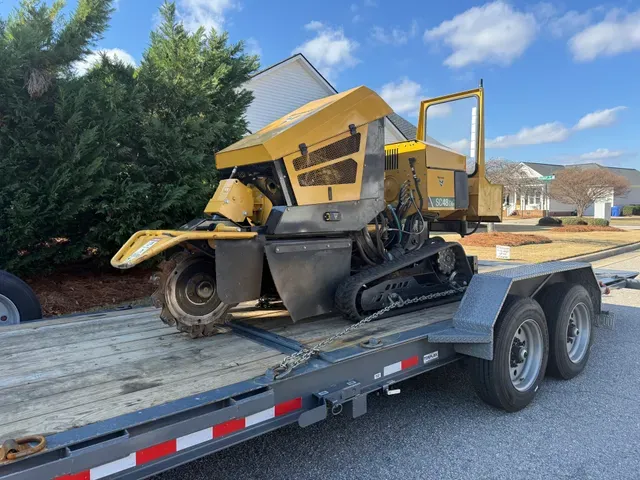
We don’t leave stumps unless you want them left. Most customers add stump grinding to their tree removal job. It’s faster and cheaper to grind the stump while we’re already on site with equipment. See our stump grinding page for details on the process and pricing.
Related Services
Pair tree removal with stump grinding for a clean finish - most customers bundle these. For multi-acre projects, our land clearing service is more efficient. Need the debris hauled? Our grapple truck handles that at $900/load. In an emergency? Our 24/7 emergency service responds fast.
Service Area
We operate out of two locations - Rocky Mount and Goldsboro - which puts us within easy reach of most of Eastern NC. Our core tree removal service area covers:
- Nash County - Rocky Mount, Nashville, Spring Hope, Bailey
- Wayne County - Goldsboro, Pikeville, Fremont, Mount Olive
- Wilson County - Wilson, Lucama, Elm City, Black Creek
- Edgecombe County - Tarboro, Pinetops, Speed
- Halifax County - Roanoke Rapids, Weldon, Enfield, Scotland Neck
- Greene County - Snow Hill, Walstonburg, Hookerton, Maury
- Lenoir County - Kinston, La Grange, Deep Run, Pink Hill
- Johnston County - Smithfield, Selma, Four Oaks, Clayton (eastern areas)
- Pitt County - Greenville, Winterville, Ayden, Farmville
Why Hire a Professional
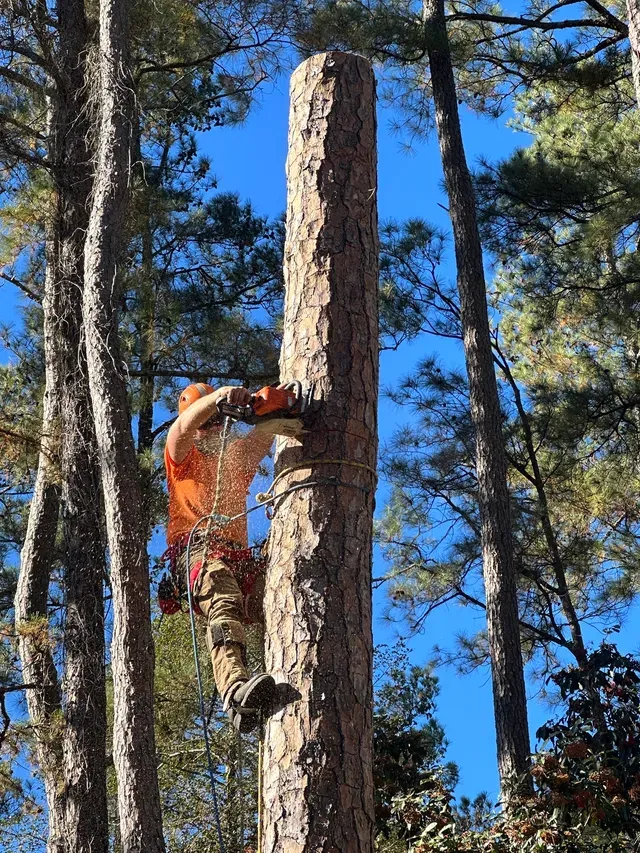
We get it - chainsaws are available at Home Depot. But there’s a reason tree work has one of the highest fatality rates of any occupation. The risks aren’t obvious until something goes wrong:
- A tree that looks like it leans left has a hidden weight bias from a heavy limb on the right.
- A cut that looks right binds the saw because the trunk is under compression you can’t see.
- A dead limb 40 feet up shakes loose when you start cutting below it.
We carry insurance for a reason, and we’ve built the experience to read trees before we cut them. That’s what you’re paying for - not just the cutting, but knowing where and how to cut.
Get a Free Estimate
Call (252) 506-0099 or email now@dctreecutting.com. We’ll schedule a site visit, walk the job with you, and have a quote typically within 24 hours. For our Goldsboro office, call (919) 276-0144.
Typical Price Range
$300 - $3,000+
Actual price depends on the specific job.