What Forestry Mulching Is
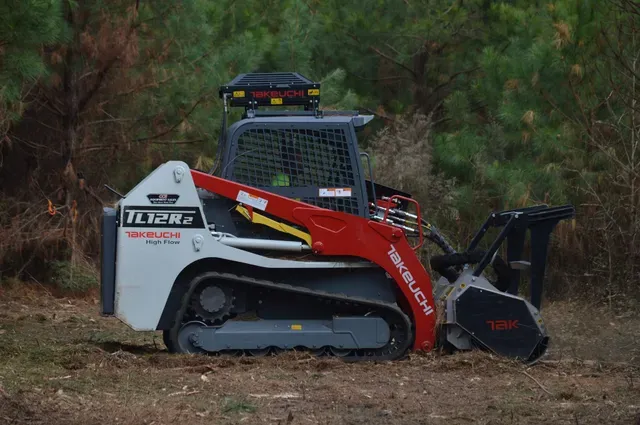
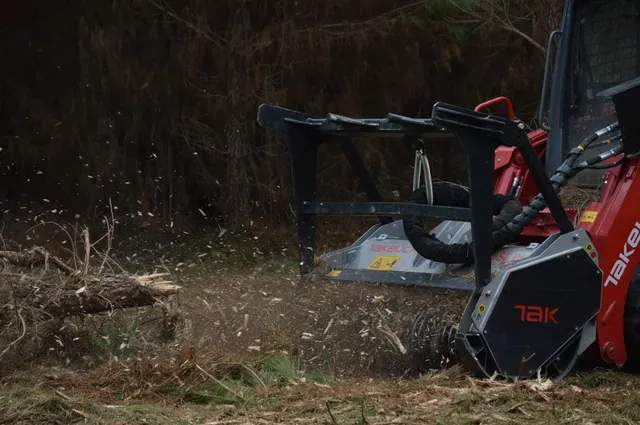
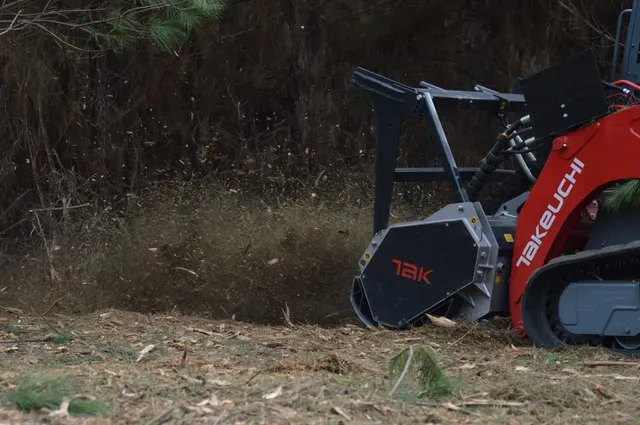
Forestry mulching is using a purpose-built mulching head attached to heavy equipment to grind standing vegetation - brush, saplings, small trees, vines, and undergrowth - into mulch in a single pass. The machine drives through the vegetation and the rotating drum with carbide teeth chews everything in its path into chips that lay flat on the ground.
No cutting trees and stacking them. No dragging brush to a pile. No chipping. No hauling. No burning. The material goes from standing to mulch without leaving the property. That’s why forestry mulching is faster and cheaper than traditional clearing for the right applications.
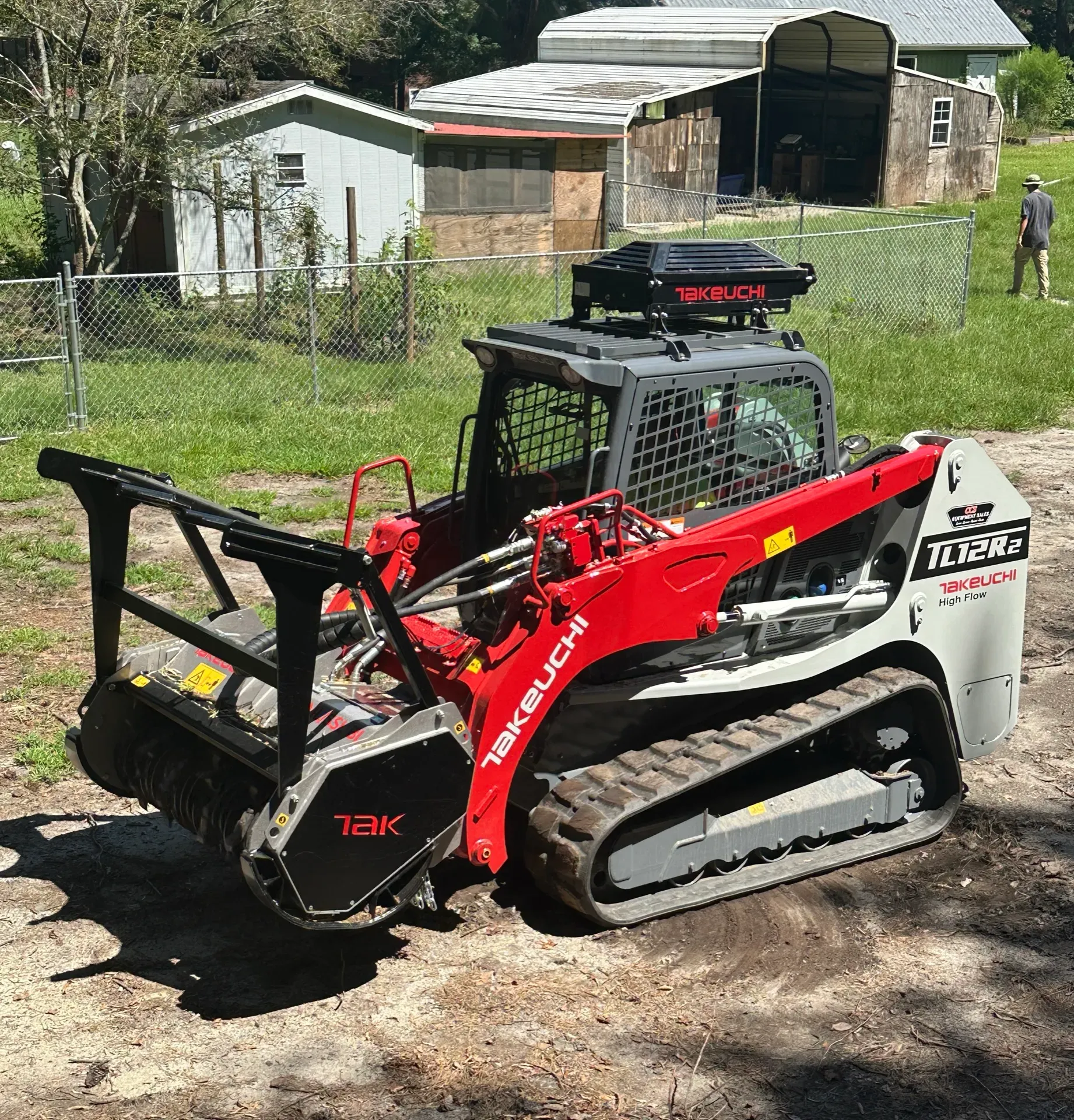
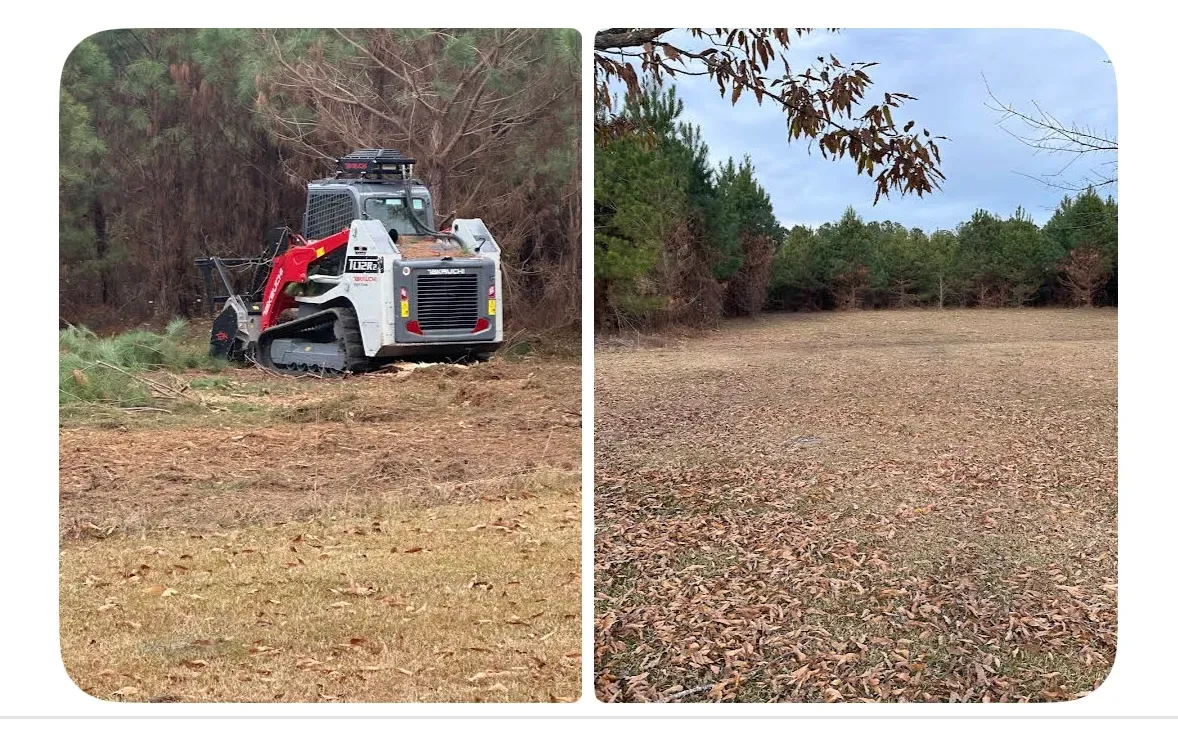
We run a Takeuchi TL12R2 compact track loader with a FAE mulcher head - one of the best combinations for the kind of work we do in Eastern NC. The tracked undercarriage handles soft ground and slopes without tearing up the terrain the way wheeled equipment does. The FAE head is aggressive enough to eat 6-8 inch diameter trees in a single pass.
How It Works
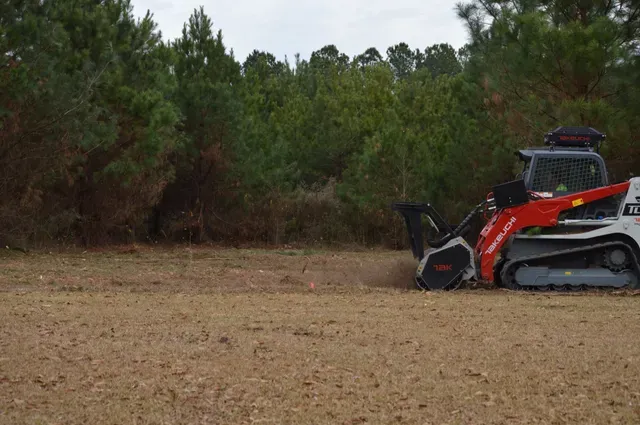
The operator drives the Takeuchi into the vegetation and lowers the mulcher head. The drum spins at high RPM with fixed carbide teeth. As the machine advances, the teeth grab standing brush and trees, grinding them from the top down. Material is processed and expelled behind/beneath the machine as a layer of chips on the ground.
A skilled operator can clear a path 5-6 feet wide per pass, working systematically across the property. The mulcher handles:
- Standing brush and scrub - privet, wax myrtle, blackberry, honeysuckle, and all the invasive stuff that takes over neglected land in Eastern NC
- Saplings and small trees - pine, sweetgum, cedar, poplar up to 6-8 inches in diameter
- Vines - kudzu, poison ivy, Virginia creeper, muscadine grape
- Tall grass and weeds - though this is overkill for just grass
- Small stumps - stumps under 6 inches get ground at grade level during the pass
The resulting mulch layer is typically 2-4 inches deep and covers the ground uniformly. It looks clean and park-like compared to the tangled mess that was there before.
When Forestry Mulching Is the Right Choice
Forestry mulching isn’t the right tool for every clearing job. Here’s where it makes the most sense:
Overgrown Lots and Properties
The most common call. A residential lot, a vacant parcel, or a property boundary that hasn’t been maintained in years. Brush has grown 8-12 feet tall, saplings have established, and you can’t even walk through it. The mulcher turns this into a clean, walkable property in a day.
This is bread-and-butter work for us in Nash, Wayne, and Wilson counties especially. Property owners who’ve let a back lot go, landlords with vacant parcels that have grown up, estate properties that need to be cleaned up for sale.
Fence Line Clearing
Brush growing into and through fence lines is a constant problem on rural properties. You can’t get a mower close enough, and hand clearing is brutal work. The mulcher runs along the fence line and clears everything on your side. One pass and it’s done for the season.
Right-of-Way Maintenance
Utility easements, access roads, pipeline corridors, ditch banks. Any linear corridor that needs vegetation kept back. Forestry mulching is the fastest way to reclaim an overgrown right-of-way. We work with property owners and utility companies on right-of-way maintenance across Edgecombe, Halifax, and Pitt counties.
Firebreak Creation
Creating defensible space around structures or between wooded areas. A mulched firebreak removes fuel from the ground level, creating a gap that slows or stops the spread of a ground fire. Common on hunting properties and rural homesteads.
Hunting Land Management
Opening up shooting lanes, creating food plot sites, thinning undergrowth for better visibility and access. Hunters and hunting clubs use forestry mulching to manage their properties without the cost and disruption of traditional clearing. The mulch left behind stabilizes the soil and provides a base for seeding food plots.
We do a lot of hunting land work across Halifax, Edgecombe, and Pitt counties where there are large hunting properties.
Site Prep - Phase 1
For construction projects on wooded lots, forestry mulching is often the first step. The mulcher clears all the underbrush and small trees, giving the clearing crew clear access to the larger timber. It also exposes the terrain so you can see what you’re working with before bringing in the excavator.
This two-phase approach - mulch first, then fell large trees and grade - is more efficient than trying to clear everything with an excavator from the start.
Pasture Reclamation
Agricultural land that’s gone fallow grows up fast in Eastern NC. A field that hasn’t been worked in 5-10 years can have substantial woody growth. Forestry mulching clears the woody vegetation and leaves a mulch layer that breaks down into organic matter. After a season, the field can be disked and returned to production.
Forestry Mulching vs. Traditional Clearing
| Factor | Forestry Mulching | Traditional Clearing |
|---|---|---|
| Speed | Faster for brush/small trees | Faster for large timber |
| Cost per acre | Lower for light-medium density | Can be lower for heavy timber (log value offsets cost) |
| Debris hauling | None - mulch stays on site | Requires truck/grapple or burn |
| Soil disturbance | Minimal - tracks don’t dig like tires | Higher - excavator and equipment tear up soil |
| Erosion control | Mulch layer protects soil immediately | Bare soil requires erosion measures |
| Stump removal | Surface level only for small stumps | Full removal possible with excavator |
| Tree size limit | 6-8” diameter max | No limit |
| End result | Mulched ground cover | Bare dirt (if stumps removed) |
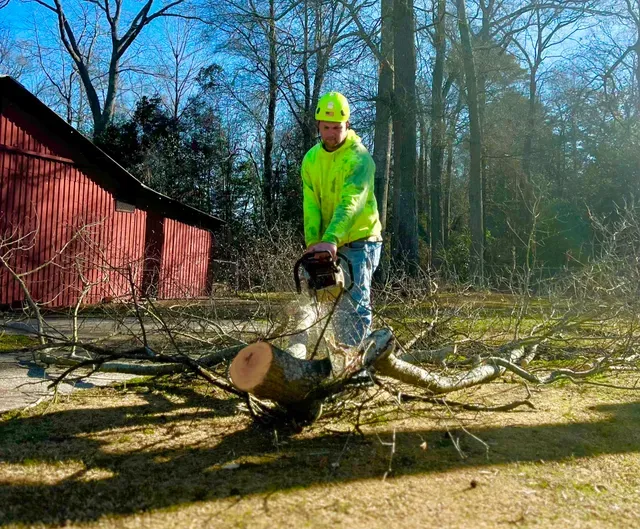
For most overgrown residential lots in Eastern NC where the growth is brush and saplings with scattered larger trees, forestry mulching handles 80-90% of the vegetation. We fell the handful of larger trees with a chainsaw and the mulcher takes care of everything else.
Pricing
Forestry mulching pricing depends primarily on three things: how dense the vegetation is, what diameter the material is, and how the terrain affects machine speed.
| Density Level | Description | Typical Cost Per Acre |
|---|---|---|
| Light | Grass, scattered brush, few saplings | $1,200 - $1,800 |
| Medium | Dense brush, saplings to 4”, tangled growth | $1,800 - $2,500 |
| Heavy | Wall-to-wall growth, trees to 6-8”, vines | $2,500 - $3,500+ |
Minimum Job Charge
We have a minimum job charge of approximately $1,200 for forestry mulching because of equipment mobilization. Loading, transporting, and unloading the Takeuchi and mulcher head takes time and fuel regardless of job size. A quarter-acre lot and a two-acre lot cost the same to mobilize for.
What Saves You Money
- Access. If we can drive the Takeuchi off the trailer and straight into the work area, we’re efficient. If we have to navigate through gates, around structures, or across soft ground to reach the work area, that adds time.
- Flat terrain. The mulcher works fastest on flat to gently rolling ground. Slopes slow the machine down and require more careful operation.
- Uniform vegetation. A field of consistent brush mulches faster than a mix of brush, trees, stumps, and debris piles.
- Volume. Larger jobs have a lower per-acre cost because mobilization spreads across more acres.
Related Services
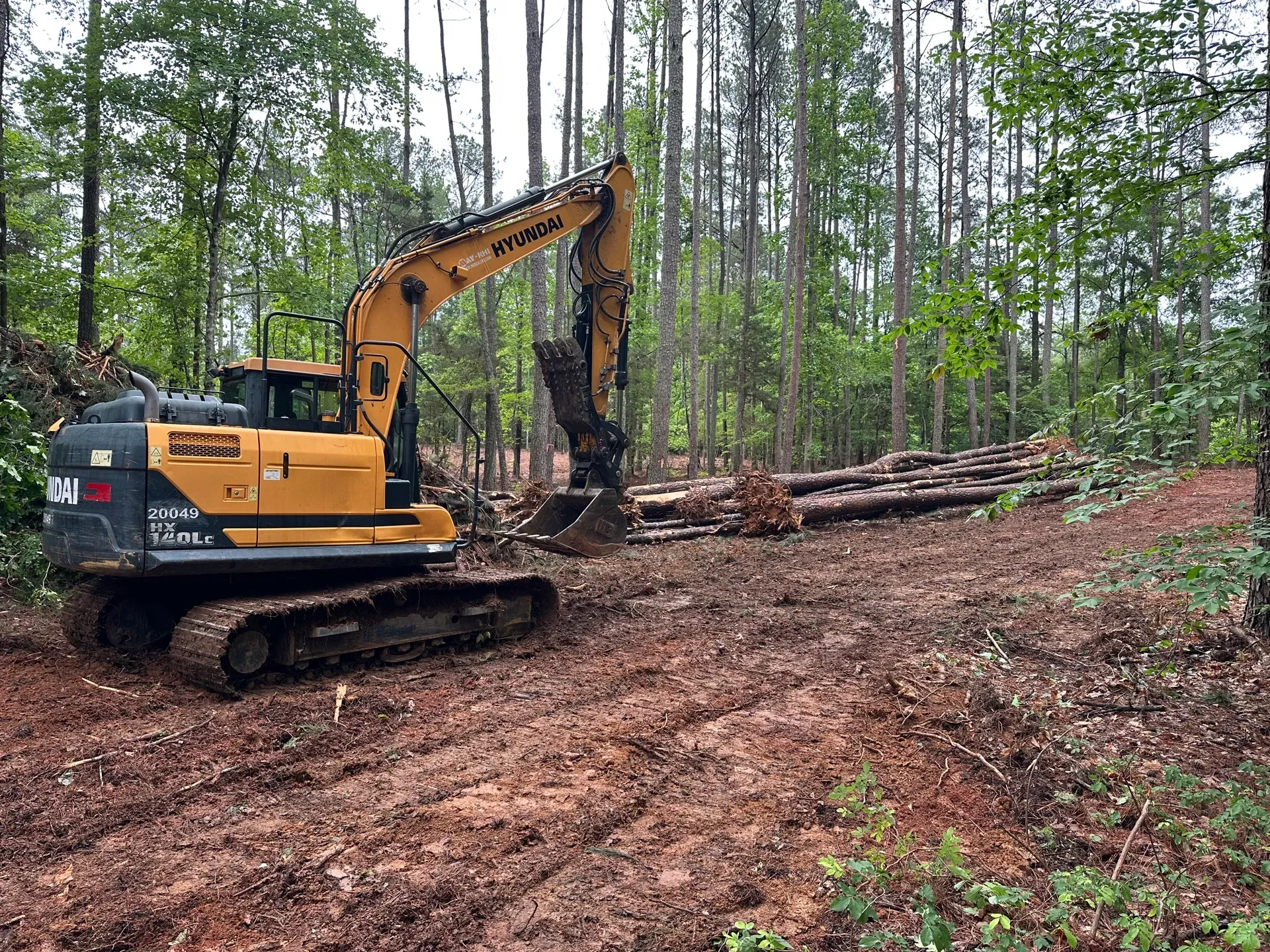
For larger projects with heavy timber, you may need full land clearing with our excavator. After mulching, debris hauling is available through our grapple truck service. If trees need to come down first, see our tree removal page.
What Forestry Mulching Won’t Do
Being honest about limitations:
- Large trees. Anything over 8 inches in diameter needs to be felled conventionally. The mulcher will process it once it’s on the ground if it’s cut into manageable pieces, but it can’t take down a 20-inch oak.
- Deep stump removal. Small stumps get ground at surface level. If you need stumps out for construction, you need a grinder or excavator.
- Bare dirt. Forestry mulching leaves a mulch layer. If you need clean mineral soil for construction, you need traditional clearing to follow.
- Wet ground. Even tracked equipment has limits. If the ground is saturated, the machine will sink and tear up the terrain. We’ll postpone rather than make a mess.
- Extremely rocky terrain. Hidden rocks damage the mulcher teeth. Eastern NC is generally rock-free, but fill dirt with concrete rubble is a different story.
Service Area
We operate the forestry mulching service from both offices:
- Nash County - Rocky Mount, Nashville, Spring Hope, Castalia
- Wayne County - Goldsboro, Pikeville, Fremont, Mount Olive
- Wilson County - Wilson, Lucama, Elm City, Stantonsburg
- Edgecombe County - Tarboro, Pinetops, Leggett
- Halifax County - Roanoke Rapids, Weldon, Enfield, Scotland Neck
- Greene County - Snow Hill, Walstonburg, Hookerton, Maury
- Lenoir County - Kinston, La Grange, Deep Run, Pink Hill
- Johnston County - Smithfield, Selma, Four Oaks, Benson
- Pitt County - Greenville, Winterville, Ayden, Farmville
Get a Free Estimate
An on-site estimate is the only way to quote forestry mulching accurately. Aerial photos help us understand the scope, but we need to walk the property to assess density and diameter. Call (252) 506-0099 or email now@dctreecutting.com to schedule. Goldsboro area: (919) 276-0144.
Typical Price Range
$1,200 - $3,500 per acre
Actual price depends on the specific job.