Utility Corridor Clearing & Waterline Tree Removal in NC
 Anthony Caracappa 14 min read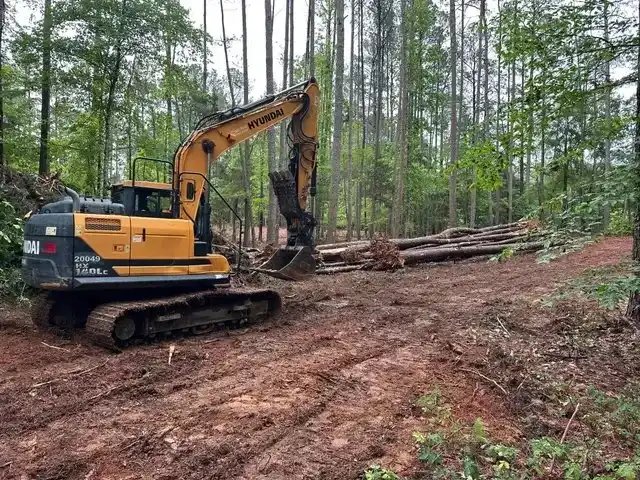


Want a firm price instead of a ballpark? Free estimate in about 2 minutes.
Get Free EstimateTable of Contents
Utility Corridor Clearing & Waterline Tree Removal in Eastern NC
Picture this: the pipe crew is 400 feet behind you and closing. The inspector shows up at noon for a walk-through. The property owner along the easement has called the project manager twice this morning because she thinks your pin flags are on her side of the line. You’ve got 30 feet of corridor to drop a 70-foot pine that has to land clean — no equipment, no pipe, no traffic, no mailbox. The silt fence is 18 inches from where you want to stage debris.
That’s a Tuesday on a waterline replacement project.
I’m Anthony Caracappa, owner of DC Tree Cutting and Land Service. Most residential tree services aren’t built for this kind of work. They show up with a chip truck and a chainsaw, expect to pile brush on site, and disappear when the job hits a complication. That’s fine for a backyard pine. It does not work on an active utility corridor.
Our biggest commercial work to date has been municipal infrastructure clearing — street-tree removal ahead of a town-wide waterline replacement, as a subcontractor to two general contractors. This post is for the civil engineers, project managers, and GCs scoping tree removal into a construction bid — what’s different about corridor work, what we need from you to price it, how phasing and documentation actually work, and the things most subs don’t tell you about commercial construction work.
For broader commercial tree service capabilities across HOA, property management, and municipal accounts, see the service page. Also relevant: HOA tree maintenance contracts if your portfolio includes community associations, and our property manager tree service hiring guide for insurance and documentation requirements on commercial work.
What’s Different About Utility Corridor Clearing
Corridor work is a different job from residential removal. The trees are the same — same loblolly pines, same water oaks, same sweetgum. Everything around the trees is different.
The corridor is active. The pipe crew is laying line 400 feet behind you. Traffic control has one lane closed. The resident project rep is on site. The property owner is watching from the porch and called the project manager already this morning. You can’t pause to think — you plan before you mobilize and execute on schedule.
The working width is tighter than it looks. Permanent waterline easements are usually 15-20 feet wide. Permanent sewer easements run 20-30 feet. Add the temporary construction easement (TCE) on one or both sides and you might have 30-50 feet of working corridor. But TCE boundaries are enforced — step outside the TCE and you’ve damaged adjacent property, which becomes a claim. You’re still dropping 70-foot pines inside a corridor that’s narrower than the tree is tall. Every tree comes down piece by piece, rigged from the top, even when residential pricing on the same tree would be a straight push-and-fell.
You can’t pile material. Residential clearing leaves brush piles for a grapple truck to come back for tomorrow. On a utility corridor, a brush pile blocks the pipe crew’s access, violates the silt fence perimeter, and flags a fire hazard when the inspector walks through. Material gets loaded and hauled the same shift it comes down — full stop.
The erosion control plan is not a suggestion. North Carolina’s Sedimentation Pollution Control Act requires an E&SC plan for any land disturbance over one acre (some municipalities: half an acre). Silt fence, construction entrance, inlet protection — all of it has to be installed and inspected before a single tree comes down. Violations are reportable to NCDEQ DEMLR. On federally-funded projects add NPDES NCG010000 compliance and weekly self-inspections. We clear behind erosion control, not ahead of it.
The schedule is not yours. On a residential job we set the schedule. On a construction project the GC owns the CPM, the inspector sets walk-through windows, the utility owner sets shutdown dates for live-line coordination, and NCDOT sets lane closure windows if you’re anywhere near state ROW. We work around all four.
These are the constraints that separate a $1,500 residential tree from a $2,500 corridor tree. A 24-inch pine is a 24-inch pine. What costs more is rigging it down into a 20-foot corridor instead of pushing it over, staging a grapple truck at the access point to haul continuously, and paying someone to write haul tickets and shoot timestamped photos every shift.
Where the Cheap Bid Blows Up
Here’s the failure mode, and every engineer who’s run corridor work has seen a version of it. A tree service that isn’t built for corridor work does the math on an acre basis and comes in well under everyone else. Then a tree goes the wrong way - across the TCE, into an adjacent property. The property owner files a claim. The contractor is carrying residential-grade liability with no additional insured endorsement for the engineering firm or the owner, so the claim lands on the owner’s policy. The contractor gets removed mid-phase, a replacement crew has to mobilize on short notice, and the schedule slips weeks.
The savings on paper evaporate the first time something goes sideways, and something always goes sideways on a multi-month corridor project. That’s why the insurance section of this post is longer than the pricing section.
A Real Project: Town-Wide Waterline Replacement in Halifax County
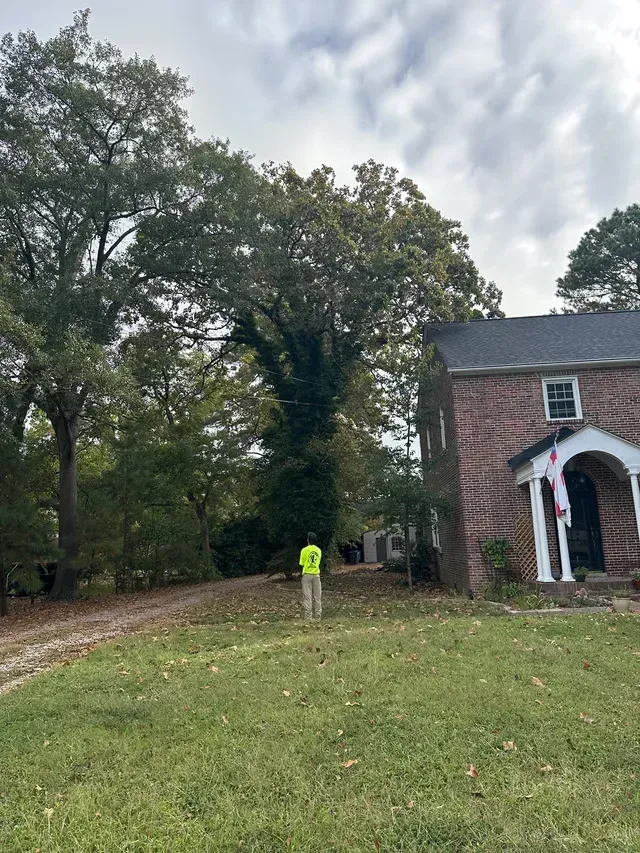
Our largest infrastructure project to date: tree removal ahead of a waterline replacement across Scotland Neck, in Halifax County. The town’s streets needed dozens of mature trees out of the way - many of them compromised, most of them tight against power lines and houses - so the pipe crews could replace the water line with the stumps and root systems out of their path.
Project detail:
- Role: tree removal and stump work subcontractor to two general contractors across four phases
- Timeline: January 2024 through September 2025 - about 30 working days on site over 20 months
- Scope: roughly 58 trees plus stump work at about 35 addresses along the town’s streets
- Constraints: live power lines through the crowns, houses and businesses within falling distance, town traffic to manage, per-address coordination with homeowners
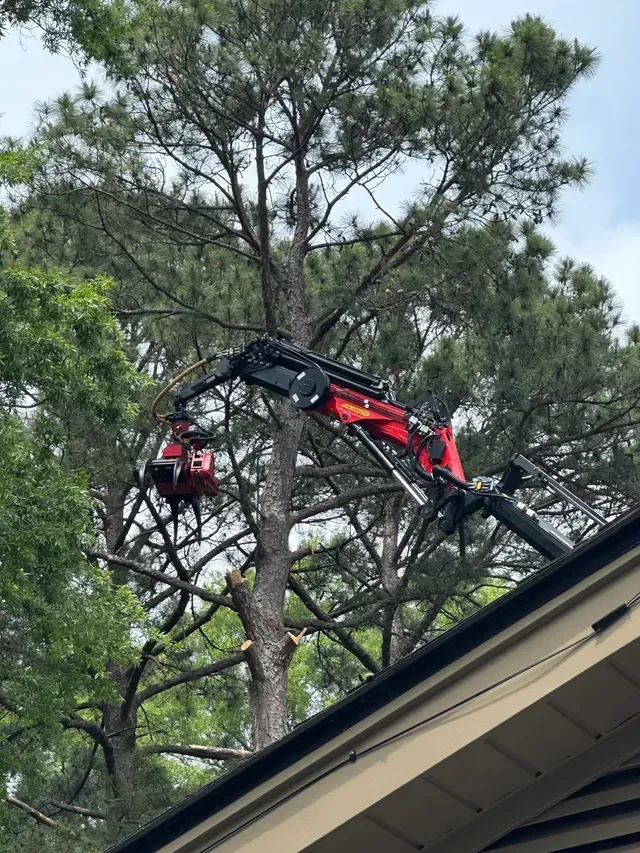
- Heavy lift: the final phase took down three of the largest street oaks - six-foot bases, live primary overhead - with a 65-ton all-terrain crane from our crane partner
- Disposal: everything hauled to the town’s dump per the contract
Two things made this work: phasing and coordination. Each phase had a defined scope, a fixed price, and a schedule that tied to the GC’s pipe work. And on a job like this the cutting is honestly the easy part - the hard part is juggling traffic control, the power company, homeowners, the crew, and the equipment in the middle of a town, phase after phase, without an incident. Both general contractors brought us back for the next phase. That’s the reference that matters.
How Corridor Tree Removal Fits Into Your Construction Schedule
The sequence on most utility projects in Eastern NC:
- Preconstruction meeting (PCM) — owner, engineer, GC, inspector, and subs walk through the baseline schedule, submittal log, and RFI process. We attend the PCM when the project calls for it.
- Preconstruction video and photo documentation of the corridor and adjacent property — standard practice to head off later property damage claims.
- NC811 design ticket, then construction locate ticket — the construction ticket is valid 15 days and must be refreshed. We don’t unload the excavator until the locates are current.
- E&SC installation and inspection — silt fence, construction entrances, inlet protection all in place and signed off by the sedimentation inspector before ground disturbance. Tree clearing is ground disturbance.
- Tree protection fencing for any keep-trees or adjacent trees specified in the plan set — standard orange fencing at the critical root zone drip line.
- Phase 1 clearing — first defined segment, typically sized to give the pipe crew a 1-2 week head start.
- Pipe install in Phase 1 while we move to Phase 2 clearing.
- Continuous phasing — usually 2-4 phases per mile of corridor depending on density and pipe crew production rate.
- Final clearance walk — engineer and GC verify clearing is complete to spec, sign off punch list.
We sequence around your critical path. If pipe needs to be in the ground by a contract milestone date, we back-plan clearing to deliver each segment ahead of that date with margin for weather and unforeseen conditions.
Pricing Structure for Utility and Waterline Work
Engineers bid this work as lump sum or linear-foot. We quote either way — what we won’t do is time-and-materials hourly pricing on a construction project. Hourly aligns our incentive wrong and engineers need a number for the bid sheet.
Lump sum per phase. Most common structure. We walk the corridor, count the trees, factor in access, corridor width, and disposal distance, and quote a fixed price per phase. Engineer knows what each phase costs before we mobilize.
Per linear foot of corridor. For longer projects where tree density is consistent and the engineer wants per-LF pricing for the bid sheet. Typical Eastern NC waterline corridor runs $8-$20 per linear foot for clearing at a standard 30-foot working width, depending on tree density and disposal method.
Per acre of clearing. Used when the corridor opens into a substation site, lift station footprint, or laydown yard. Typical range:
| Scope | Cost per acre |
|---|---|
| Light brush and pine under 12” DBH, mulched in place | $2,500-$4,500 |
| Mixed pine and hardwood to 20” DBH, offsite haul | $5,000-$9,000 |
| Heavy corridor, 24-36” DBH hardwoods, offsite haul, tight access | $10,000-$18,000 |
| Stump grinding add-on, 6-inch depth | $1,500-$4,000 |
Mobilization runs $1,500-$3,000 depending on distance from our Rocky Mount HQ or Goldsboro yard. Traffic control with certified ATSSA flaggers — if required — runs $500-$1,500 per day on top of the clearing price.
Multi-phase contracts get phase-based pricing efficiency. Equipment is staged, crew is familiar with the project, the per-phase number on Phase 3 is lower than Phase 1. That savings passes through to you.
For comparison pricing on residential and general land clearing outside of construction contexts, see our land clearing cost guide. Construction pricing is a different animal — these numbers only apply to utility, corridor, and GC subcontract work.
Documentation We Provide
Utility and construction projects need documentation that matches the GC’s reporting format. What we send by default:
- Certificate of insurance within 24 hours of subcontract execution, naming the GC and project owner as additional insured. If your contract requires specific endorsement forms, we confirm them with our agent before mobilization.
- Daily field report — crew count by classification, hours by activity, equipment hours, quantities (linear feet cleared, trees removed, loads hauled), weather conditions, delays, visitors on site, and any safety incidents. Matches the AIA G702-style reporting most GCs use.
- Debris haul tickets with load count, tonnage or CY, dump location, and time stamps.
- JHA / pre-task plans — submitted to the GC before each new task or new phase. Standard OSHA-aligned format covering hazards, controls, PPE, and emergency response.
- Toolbox talks — weekly safety meetings documented with attendance, topic, and signatures. Required by most commercial GCs.
- Certified payroll (WH-347) on Davis-Bacon projects, submitted weekly with fringe benefits documented. We handle federal prevailing wage reporting on EPA SRF/DWSRF, USDA Rural Development, HUD CDBG, and FEMA-funded projects.
- Final clearance walk-through with engineer or project manager, punch list sign-off.
For NCDOT and municipal contracts, we match whatever format the spec requires.
Bonding, DBE, and Other Contract Details
Commercial utility work raises questions residential work never does. Here’s where we stand:
Performance and payment bonds. We can obtain performance and payment bonds when a contract requires them. For subcontract scope under $100K most GCs waive bonding requirements; over $100K, expect it to be required — flag it in the bid package so we price it in.
DBE / MBE / WBE. We are not currently DBE-certified. On federally-funded projects with DBE goals we partner with certified firms where the scope allows. If your project has hard DBE goals that require a certified prime or sub on the clearing scope specifically, we can structure a partnership with a certified firm.
NC HUB certification. We are not currently HUB-certified. On NC state-funded projects with HUB goals we operate the same way as DBE — partnership or referral.
Prevailing wage. We handle Davis-Bacon rates and reporting. NC has no state prevailing wage law, so outside federal funding there’s no certified payroll requirement. If your project is federally-funded, we need the wage determination and classification schedule with the bid package so we can price labor correctly.
Safety compliance. OSHA 10 certified crew, OSHA 30 certified lead. ANSI Z133-2017 compliance on all arboricultural operations. Competent person designation on every crew. We do not handle confined space entry (manholes, vaults) — that’s the pipe crew’s scope.
Licensing. North Carolina doesn’t require a specific license for tree work. For projects where the scope crosses NC General Contractor licensing thresholds ($40K including grading scope), we structure the work with an appropriately licensed partner.
Equipment for Confined Utility Corridors
Standard residential clearing equipment doesn’t fit utility work. A 30-foot working corridor doesn’t have room for a wheeled loader. Our core fleet, plus operator partners for the heavy iron:
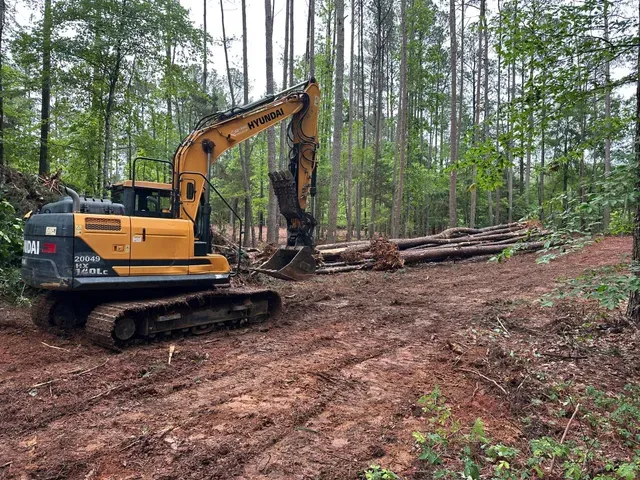
- Tracked excavator (through our operator partners). A 12-ton-class machine like the Hyundai HX120LC fits inside the TCE on most corridor projects and pushes pine up to about 14 inches DBH reliably. For larger hardwoods the excavator holds the trunk while the chainsaw crew cuts. We schedule the operator with the phase.
- Takeuchi TL12R2 with FAE mulcher head. 12,800 lb compact track loader, flow-matched to the mulcher. Handles brush and trees up to 6-8 inches in a single pass. This is also our forestry mulching machine for ROW vegetation management work outside of active construction.
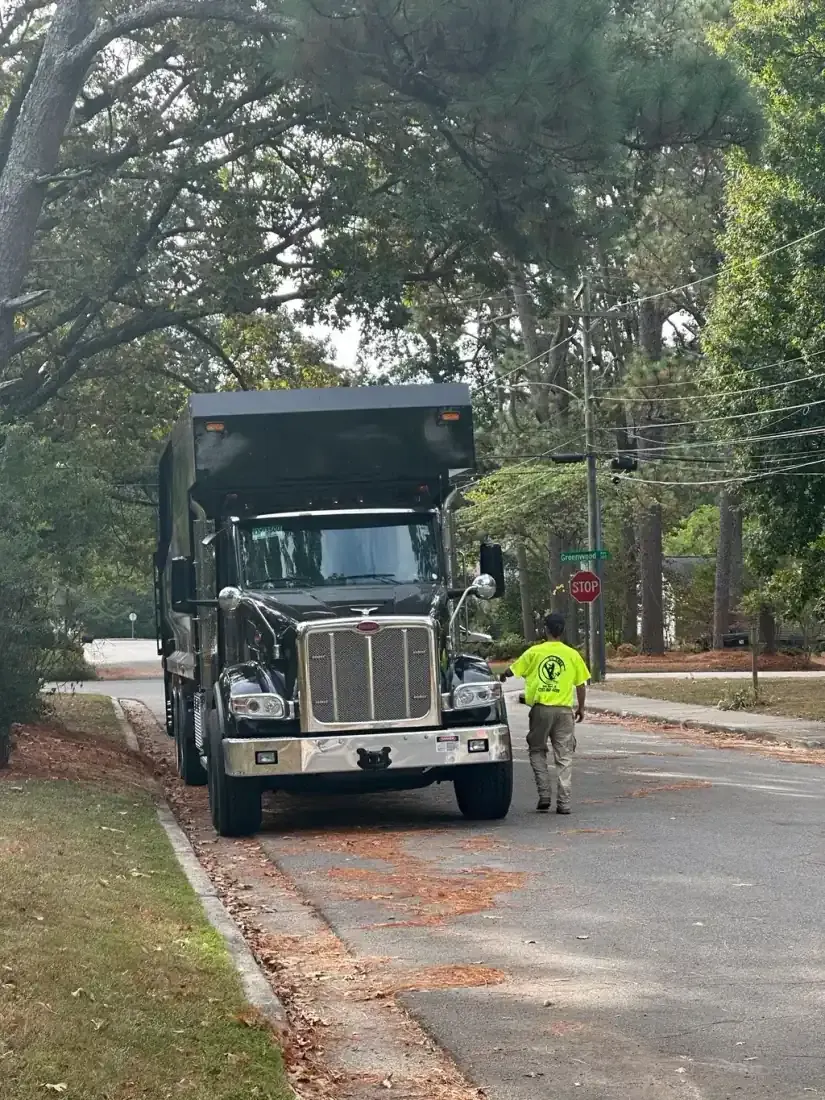
- Peterbilt grapple truck. Staged at the corridor access point, runs continuously during clearing operations. For residential context on grapple truck pricing and debris handling, see grapple truck vs dumpster rental. On commercial projects we roll grapple operations into the lump sum rather than quoting per-load.
- Bobcat skid steer. Moves debris in tight sections, feeds the grapple truck, works where the excavator can’t pivot.
- Climbing gear and chainsaws. Precision rigging for trees that can’t be pushed safely — adjacent to pipe staging, over keep-trees, near overhead lines, or inside narrow TCE boundaries.
For larger-scale land clearing where a corridor opens into a full site (substation pad, lift station, laydown yard), we bring additional equipment and crew for the higher production rate.
Service Area for Construction & Utility Work
Our commercial scope is wider than our residential service area. Multi-month construction contracts justify the travel that one-off residential jobs don’t. We work construction projects across:
- Eastern NC counties: Nash, Wayne, Wilson, Edgecombe, Halifax, Johnston, Pitt, Greene, Lenoir, and adjacent counties for qualifying project work
- Two yards: Rocky Mount HQ and Goldsboro yard for equipment staging and crew access
For projects in adjacent counties or southeast Virginia, we evaluate based on scope and duration. Larger multi-month projects justify wider travel.
Working With Engineering Firms in Eastern NC
If your firm is scoping utility, waterline, sewer, roadway, or site development construction with tree removal in scope, call us at the design or bid stage — not after award. We’ll do a free site walk, give you a price for the bid package, and be ready to mobilize when the notice to proceed comes through.
What makes a tight bid: site plan with corridor width, station limits, and easement lines marked. Phasing schedule with key milestones. Survey or LiDAR data showing tree locations and approximate diameters if available. Scope on disposal (haul offsite, burn where permitted, stage for owner). Documentation format requirements.
What we need to mobilize: executed subcontract (AIA A401 or ConsensusDocs 750 preferred), notice to proceed, permits in hand, COI requirements confirmed, preconstruction meeting completed.
For a broader look at vetting tree contractors — insurance, crew, equipment, red flags — see our hiring guide for tree services in Eastern NC.
Call (252) 506-0099 or email now@dctreecutting.com for a bid. For general inquiries, request an estimate online. For commercial property managers coordinating tree work across multiple properties, see our guide on what property managers should know before hiring a tree service.
Frequently Asked Questions
Do you clear utility corridors in Eastern NC?
Do you do tree removal for waterline construction projects?
Can you work under NCDOT encroachment permits?
What insurance do you carry for utility and construction work?
How much does tree removal cost for a utility or waterline construction project?
Can you phase tree removal to match a construction schedule?
What documentation do you provide for utility and construction projects?
Owner, DC Tree Cutting and Land Service
Anthony runs DC Tree Cutting from Rocky Mount, NC. Every article is based on real jobs, real equipment, and real pricing from across Eastern North Carolina. More about Anthony →