March 16, 2026 by Anthony Caracappa
How Much Does Tree Removal Cost in Eastern NC?
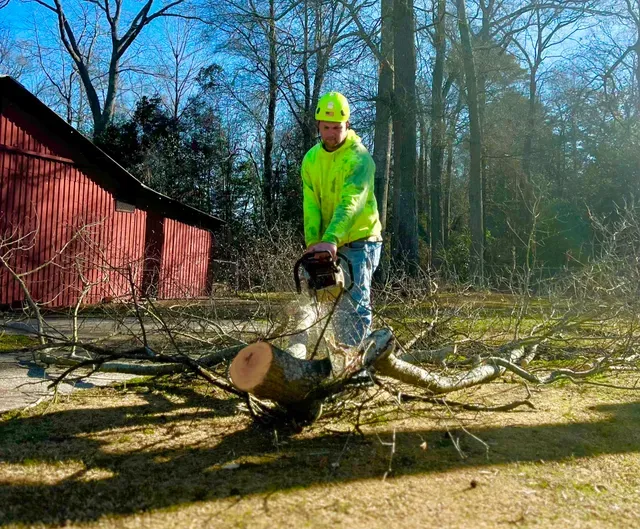
Why Is It So Hard to Get a Straight Answer on Tree Removal Cost?
If you’ve spent any time searching “how much does tree removal cost” online, you already know the drill. Every website gives you the same recycled national averages that have nothing to do with Eastern North Carolina. Or they give you a range so wide it’s useless - “$200 to $20,000” - thanks for nothing.
I’m Anthony Caracappa, owner of DC Tree Cutting and Land Service. We run crews out of Rocky Mount and Goldsboro, and we cover nine counties across Eastern NC. I got tired of potential customers calling us with no frame of reference for what a tree removal actually costs, so I pulled real numbers from our last 200+ completed jobs and put this together. No filler, no national averages, no made-up scenarios. Just what people in Nash, Wayne, Wilson, Edgecombe, and the surrounding counties are actually paying.
I know publishing pricing makes some tree service owners uncomfortable. The way I see it, you deserve to know what you’re getting into before you pick up the phone. And if our numbers aren’t in your budget, that’s fine - at least you’re making an informed decision instead of guessing.
The Short Answer
Most residential tree removals in Eastern NC fall between $1,500 and $5,000. If I had to give you one number to plan around, $2,500 is right in the middle of what we see on a typical job.
But that range is wide for a reason. A 25-foot pine standing alone in the middle of a flat yard is a completely different job from an 80-foot water oak hanging over your roof with a power line running through the canopy. One takes a couple hours. The other takes a crane, a traffic control plan, and a full day with a four-man crew. The price reflects that.
About a fifth of our jobs come in under $1,000 - usually small trees in open areas, straightforward work. The bulk of our residential work, roughly a third, lands in that $2,000 to $3,000 range. Around one in five jobs runs $3,000 to $5,000, and a smaller percentage goes above $5,000 for the big, complicated removals.
What Drives Tree Removal Cost Up
Size
This is the biggest factor, and it’s not just about height. A tall skinny loblolly pine is a lot less work than a short, wide-canopy hardwood with heavy lateral limbs. But as a general guide, here’s what we see based on tree height:
Small trees (under 30 feet) typically run $500 to $1,500. Think ornamental trees, small pines, dead trees that haven’t grown out yet. Fast work for a two-man crew.
Medium trees (30 to 60 feet) usually fall in the $1,500 to $3,500 range. This covers a huge portion of the residential trees in Eastern NC - your average backyard pine, a mid-size oak, sweetgum, or maple. These need more equipment, more crew time, and more cleanup.
Large trees (60 to 80 feet) run $3,000 to $6,000. We’re talking mature oaks, big tulip poplars, established pines. These take a full day in most cases and require experienced climbers or bucket truck access.
Very large trees (80 feet and up) start at $5,000 and can run to $9,000 or more. Old-growth hardwoods, massive pines that have been growing since your grandparents were kids. These often require crane work and multiple days of planning.
Species
Not all trees are created equal. A loblolly pine is relatively soft, grows straight, and drops predictably when you cut it. A water oak has heavy, unpredictable limbs that grow in every direction and wood dense enough to ruin your day if a piece falls wrong. Hardwoods generally cost more than softwoods because they take longer to process, they’re heavier to handle, and they require more precise rigging.
Proximity to Structures
A tree in the middle of an open field is one thing. A tree twelve feet from your house, leaning toward the roof, with branches over the deck - that’s a rigging job. Every limb has to come down on a rope, lowered with a friction device, and guided to the ground by a ground crew. It’s slow, methodical work, and it costs more because the stakes are higher. One mistake means a hole in your roof or worse.
Jobs in open yards typically run $500 to $2,500. When we’re rigging near a structure, you’re looking at $1,500 to $5,000. Technical removals involving cranes or work around power lines start at $3,000 and can go well past $9,000.
Power Lines
If a tree is in or near power lines, the job gets complicated fast. We coordinate with the utility company, follow specific safety protocols, and sometimes need to schedule a line de-energization. All of that adds time and cost. Do not let an uninsured crew touch a tree near power lines - that’s how people die.
Access
Can we get a bucket truck or crane to the tree? Or is it behind a fence, through a gate, up a hill, and past a septic field? Limited access means more hand-carrying, more time, and more labor. If we can back a truck right up to the tree, that saves time and keeps costs down.
Dead or Hazardous Trees
You might think a dead tree would be cheaper to remove because it’s already done growing. The opposite is usually true. Dead trees are unpredictable. The wood is brittle, limbs can snap without warning, and the trunk might be hollow or rotting from the inside. Our climbers have to take extra precautions, work slower, and sometimes we bring in a crane for safety rather than sending someone up a tree that might not hold their weight.
If you have a dead tree, don’t wait on it. It’s not getting cheaper or safer. Check out our emergency tree service page if a dead tree is actively threatening your property.
Crane Work
Some trees can only come down safely with a crane. Maybe the tree is too large to rig by hand, or it’s in a position where there’s no room for error - over a house, between two buildings, next to a pool. Crane work adds significant cost because we’re bringing in heavy equipment, an operator, and usually a larger crew. But it’s often faster and safer than trying to piece a massive tree down by hand. A tree that might take two days to rig manually can sometimes come down in four hours with a crane.
What Drives Tree Removal Cost Down
Open Yard Access
The easiest, fastest, most affordable tree removals are trees standing in the open with good truck access and nothing to hit. If we can fell the tree in one piece and process it on the ground, the job goes quickly.
Single Straight Pines
Loblolly pines are the bread and butter of tree removal in Eastern NC. They grow straight, they’re relatively light, and they come down predictably. A single pine in an open yard is about as straightforward as tree work gets.
Good Truck Access
If we can park a truck close to the work area, load debris directly, and get equipment in without hand-carrying, that saves labor hours and keeps your price down.
Bundling Multiple Trees
If you have several trees that need to come down, the per-tree cost drops. We’re already on-site with the crew and equipment, so removing three trees doesn’t take three times as long as removing one. More on that below.
Bundling Stump Grinding
Getting stumps ground at the same time as the removal is almost always cheaper than bringing the grinder back separately. One mobilization instead of two.
Real Examples From Our Work
To give you a feel for actual pricing, here are some jobs that represent common scenarios we handle across our service area.
A 35-foot dead pine in a Wilson backyard - standing in the open, good access, no structures nearby. The tree was dead but still solid. Crew dropped it in one cut, processed it on the ground, and hauled everything out in a few hours. Job came in right around $900 with stump grinding included.
A 60-foot water oak in a Rocky Mount backyard - about 15 feet from the house with limbs over the roof. Full rigging job. Every major limb had to be roped down, and the trunk was taken in sections. This was a full-day job for a four-man crew. Final price was in the $3,500 range.
Three medium loblolly pines on a property in Goldsboro - all standing in a row along a fence line, none near the house. We dropped all three, processed them, and ground the stumps in a single day. The customer got a better per-tree rate than if they’d done them one at a time. Total job was around $3,200 for all three.
An 85-foot willow oak in Nash County - massive canopy, overhanging the house and a detached garage, with a power line running through the lower branches. This was a crane job. We brought in a 60-ton crane, coordinated with the power company, and had a six-man crew on site. The tree came down in pieces over about five hours. This was a $7,500 job, but trying to rig that tree by hand would have taken three days and been far more dangerous.
A small ornamental tree in an Edgecombe County front yard - about 20 feet tall, easy access, nothing around it. Crew knocked it out in about an hour. Under $600.
Stump Grinding
We get asked about stump grinding on almost every tree removal job. Most customers want the stump gone, and it’s almost always worth doing at the same time as the removal.
Stump grinding typically runs $250 to $1,000 depending on the size of the stump and root flare. A small pine stump might be $250. A big hardwood stump with surface roots spreading six feet in every direction is going to be on the higher end.
When you bundle stump grinding with a tree removal, you save on the second trip. We’re already there with equipment, so the grinder shows up same day and knocks it out while the crew finishes cleanup. If you call us back a month later to grind a stump separately, you’re paying for another mobilization.
Multi-Tree Discounts
Removing multiple trees on the same visit is one of the best ways to bring your per-tree cost down. Here’s why: a huge portion of any tree removal cost is mobilization - getting the crew, trucks, chipper, and equipment to your property. Whether we’re removing one tree or five, that mobilization cost is roughly the same.
So if you’ve been thinking about taking down a few trees, doing them all at once makes financial sense. We’ll walk your property with you during the estimate, prioritize which trees actually need to come down, and give you a package price.
Why We’re Not the Cheapest
I’ll be straight with you - if you call around, you will find someone cheaper. Probably a lot cheaper. And I’m fine with that.
DC Tree Cutting carries all three insurance types that matter: general liability, workers compensation, and commercial auto. That’s not cheap. Based on our 200+ completed jobs, our pricing reflects what it costs to do the job legally, safely, and completely. We show up with trained crews, proper equipment, and the paperwork to back it all up.
Companies quoting 40% less than us are cutting costs somewhere. Maybe they’re skipping workers comp. Maybe they’re running without commercial auto insurance. Maybe they don’t carry liability at all. If a guy falls out of your tree and he’s not covered by workers comp, guess whose homeowner’s insurance gets the call? Yours. If a truck damages your driveway and there’s no commercial auto policy, you’re eating that cost.
I’m not trying to scare you. I’m telling you to ask every company you call for a certificate of insurance - not just “yeah we’re insured” over the phone, but an actual COI with your name on it. Any legitimate company will provide one without hesitation. If they won’t, that tells you everything you need to know.
Detailed Pricing Breakdown
For a detailed breakdown including our size-by-complexity pricing matrix, see our pricing page. It covers every combination of tree size and job complexity so you can get a ballpark for your specific situation before you even call.
Get a Free Estimate
Every property is different, and the only way to get an accurate price is to have us come look at the tree. We provide free, no-obligation estimates across all nine counties in our service area - Nash, Edgecombe, Wilson, Wayne, Halifax, Johnston, Greene, Lenoir, and Pitt.
Call (252) 506-0099 (Rocky Mount) or (919) 276-0144 (Goldsboro), or request an estimate online.
Frequently Asked Questions
Does the price include cleanup and hauling?
Yes. Every tree removal quote from DC Tree Cutting includes full cleanup and haul-off of all debris. We don’t leave a mess in your yard and charge extra to clean it up. The price we quote is the price for the complete job - the tree comes down, the debris goes away, and your yard is raked clean.
Should I get the stump ground at the same time?
Almost always, yes. Bundling stump grinding with the tree removal saves you money because we don’t have to make a second trip. The only reason to skip it is if you plan to dig the stump out yourself or you want to keep it for some reason.
How much more does it cost if the tree is near my house?
Proximity to a structure can increase the cost significantly - sometimes doubling it compared to the same tree in an open yard. The closer the tree is to your house, deck, fence, or other structure, the more rigging and precision work is required. Trees right against a house with limbs over the roofline are the most labor-intensive.
Do I need a permit to remove a tree in Eastern NC?
Most municipalities in Eastern NC don’t require permits for tree removal on private residential property. Some towns have heritage tree ordinances or restrictions in historic districts. We’ll let you know during the estimate if your situation requires any kind of permit.
Is it cheaper to remove a tree in winter?
Tree work doesn’t slow down as much in Eastern NC as it does up north, but late fall through early spring can sometimes offer more scheduling flexibility. The trees themselves aren’t cheaper to remove in winter, but if we have more availability, we can sometimes get to your job faster. Storm season (spring and summer) is our busiest time.
What’s the difference between tree removal and tree trimming?
Tree removal means the entire tree comes down - trunk, limbs, everything - and the stump is left at ground level (or ground down if you add that service). Tree trimming means we’re selectively cutting branches to improve the tree’s health, shape, or clearance while keeping the tree standing. They’re completely different jobs with different pricing. If you’re not sure which you need, we’ll advise you during the estimate.