March 15, 2026 by Anthony Caracappa
Common Trees in Eastern NC: What Every Property Owner Should Know
Why I Wrote This
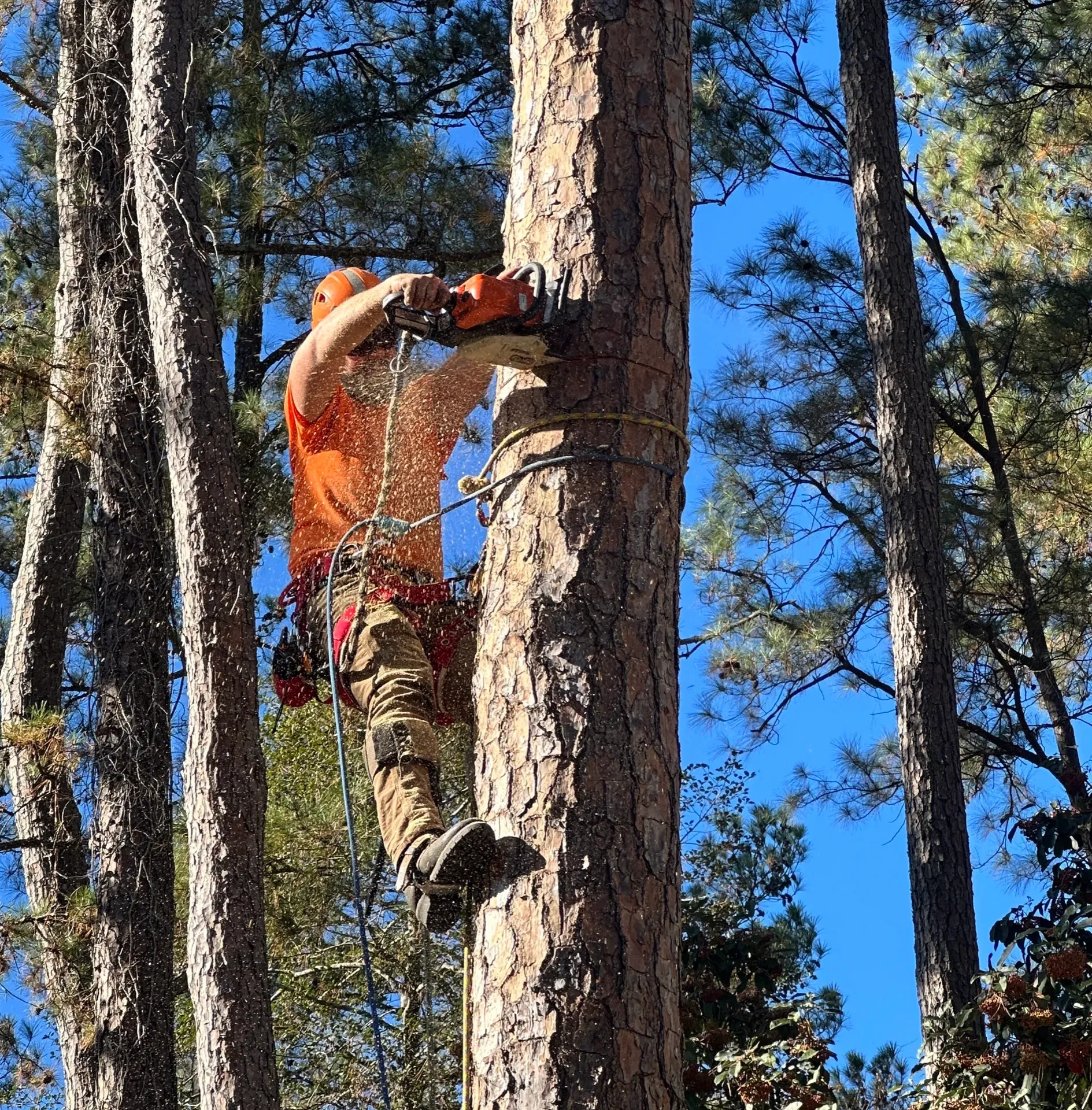
I run DC Tree Cutting and Land Service out of Rocky Mount, North Carolina. Between our Rocky Mount headquarters and our Goldsboro yard, we cover nine counties across Eastern NC. I’ve been climbing, cutting, and removing trees in this region long enough to know what each species does when it grows too big, when it gets sick, and when it decides to come down on its own during a storm.
This isn’t a botany textbook. This is what I’ve learned working with these trees every week. Which ones drop limbs without warning. Which ones are worth saving. Which ones will crack your foundation if you ignore them. If you own property in Eastern NC, you’re living with at least a few of the species on this list, and knowing what you’re dealing with can save you thousands of dollars and a lot of headaches.
Loblolly Pine
This is the tree that keeps us busiest. Loblolly pine is everywhere in Eastern NC. Drive down any road in Nash, Edgecombe, Wayne, or Wilson County and you’ll see stands of them in every direction. They grow fast, they grow tall (80 to 100 feet is common), and they grow in places where nobody planned for a 90-foot tree to end up.
Loblolly has a straight trunk, reddish-brown bark that breaks into large scaly plates as it matures, and long needles in bundles of three. Young trees have branches all the way down the trunk. Older ones look like telephone poles with a tuft of green at the top.
I’ve dropped hundreds of loblolly pines. They’re one of the more predictable trees to fell because the wood is relatively soft and the trunks are usually straight. The problems come from where people planted them (or where they seeded in on their own). A loblolly 10 feet from your house was a cute little Christmas tree 20 years ago. Now it’s got a root system pushing against your foundation and a crown that catches every hurricane gust that rolls through.
Loblolly pines are also shallow-rooted for their height. When the ground saturates after heavy rain, they blow over. I see it after every major storm. The root plate comes right out of the ground and the whole tree lays down across a house, a fence, a power line. We handle a lot of emergency calls that start with a homeowner saying “my pine tree fell.”
Pine beetle infestations are another issue. Once you see the needles turning brown from the top down and sawdust tubes on the bark, the tree is already dying. There’s no saving it at that point.
Cost: Loblolly removal typically runs $800 to $3,000 depending on height, lean, proximity to structures, and access. A straightforward pine in an open yard is on the lower end. A 95-footer leaning over your roof with power lines in the drop zone is on the higher end. Stump grinding is usually additional.
Water Oak
Water oak is the tree I get the most questions about from homeowners who don’t know what’s growing in their yard. It’s a medium to large oak (60 to 80 feet) with leaves that are spatula-shaped, wider at the tip than the base. It holds its leaves later into winter than most deciduous trees, sometimes not dropping them until January.
You’ll find water oaks in residential yards all over Eastern NC. They were planted heavily as shade trees decades ago, and a lot of them are now reaching the end of their lifespan. Water oaks are not long-lived compared to other oaks. Most start declining around 60 to 80 years, and when they decline, they do it fast.
The biggest problem with water oaks is internal rot. The wood is softer than most oaks, and once decay fungi get established in the heartwood, the tree can look fine from the outside while being completely hollow inside. I’ve cut into water oaks that looked healthy from the ground and found 6 inches of solid wood around a cavity big enough to stand in. Those are the trees that fail catastrophically during storms. No warning. Just a loud crack and the whole tree is on your house.
Water oaks also have aggressive surface roots that buckle driveways and sidewalks. If yours is lifting concrete, the root problem is only going to get worse.
When to call: If your water oak is over 50 years old, has mushrooms growing at the base, or has dead branches in the upper canopy, get it assessed. Trimming dead wood can extend the life of a declining water oak by years, but at a certain point, removal is the safer choice.
Willow Oak
People confuse willow oak with water oak constantly, but they’re different trees with different problems. Willow oak has narrow, willow-shaped leaves (that’s where the name comes from) and a more uniform, rounded crown. It’s a bigger tree than water oak on average, commonly reaching 80 to 100 feet with a massive canopy spread.
Willow oak is a stronger, longer-lived tree than water oak. It’s a good shade tree and a lot of the big, beautiful oaks you see lining older neighborhoods in Rocky Mount and Goldsboro are willow oaks. The wood is hard. When we remove a large willow oak, the crew feels it. The chips are heavy, the logs are heavy, everything about the job takes longer than the same size pine.
The problems with willow oak are mostly size-related. These trees get enormous. A mature willow oak can have a canopy spread of 80 feet or more, and the root system is equally expansive. They drop acorns by the thousands in fall, which is more of a nuisance than a structural concern. The real issue is when branches extend over roofs, driveways, and structures. Individual branches on a mature willow oak can weigh several thousand pounds. If one of those breaks in an ice storm, it’s going through whatever is underneath it.
Regular pruning is the best investment you can make in a mature willow oak. Removing dead wood and reducing overextended branches keeps the tree healthy and reduces storm damage risk. These are worth saving when they’re in good shape.
Cost: Willow oak removal runs $2,000 to $6,000 or more for mature specimens. The wood is dense, the canopy is wide, and the jobs take a full crew a full day. For large oaks near structures, we usually rig sections down rather than felling, which adds time and labor.
Pecan
Pecan trees hold a special place in Eastern NC. They’ve been on properties for generations, and homeowners are emotionally attached to them. I understand that. But pecans are also some of the most problematic trees we deal with.
One of our customers, Teresa, had us out to handle a huge pecan tree along with dying pines and dogwoods. That job is a good example of what pecan removal looks like in practice. These trees get massive. A mature pecan can reach 70 to 100 feet tall with a canopy spread to match, and the wood is incredibly dense. Pecan is one of the hardest woods we cut. It dulls chains fast and the logs are so heavy that moving them requires equipment.
Pecans are susceptible to ice damage. The branching structure creates a lot of V-crotches (places where two branches grow together at a narrow angle), and those weak unions split apart under ice load. After a serious ice storm, pecan trees look like they’ve been through a war. We’ve cleaned up pecans with 30 or 40 broken branches still hanging in the crown.
They also drop massive amounts of debris. Husks, nuts, twigs, catkins. If a pecan tree overhangs your roof, your gutters will clog constantly from April through November.
Pecan scab (a fungal disease) is common in the humid Eastern NC climate and can defoliate the tree by midsummer in bad years. It won’t kill the tree quickly, but it weakens it over time.
When to call: If your pecan has large dead branches in the upper canopy, splits at major branch unions, or is producing less fruit than it used to, those are signs of decline. Pruning can help a healthy pecan. Once structural decay sets in, you’re looking at removal.
Sweetgum
Sweetgum is one of those trees that nobody plants on purpose anymore, but they’re all over Eastern NC because they seed in aggressively on any disturbed ground. You know sweetgum by its star-shaped leaves (five pointed lobes) and the spiky gumballs it drops by the hundreds. The bark on mature trees has deep, corky ridges.
Sweetgum grows 60 to 80 feet tall and does well in wet areas. We see a lot of them in bottomland areas, along ditches, and on the edges of fields. They’re common on properties that were partially cleared at some point. If you cleared land five years ago and didn’t maintain it, sweetgum is probably one of the first trees that came back.
The wood is moderately hard, and the trees have a reputation for being “stringy” when cut. The grain twists, which makes the logs difficult to split and can cause them to react unpredictably during felling. My crew and I approach sweetgum carefully for this reason.
The main complaints homeowners have about sweetgum are the gumballs (they’re a nightmare to walk on barefoot and they’ll trip you on a slope), surface roots that tear up lawns, and the tree’s tendency to send up root suckers everywhere. Cut down a sweetgum and you’ll spend the next two years mowing down sprouts unless you grind the stump below grade and treat the root zone.
Cost: Sweetgum removal is typically $800 to $2,500. They’re common in land clearing jobs where we’re taking out multiple trees to reclaim overgrown lots.
Red Maple
Red maple grows almost everywhere in Eastern NC. It’s adaptable, it handles wet feet and dry soil equally well, and it puts on a good show in fall. You’ll find red maples in yards, along roadsides, in swamps, and at the edges of farm fields. The leaves have three main lobes with serrated edges, and the twigs and buds are reddish year-round.
Red maples grow 40 to 60 feet tall in most settings. The wood is moderately soft compared to oaks, which means the trees are more susceptible to storm damage. Red maples have a tendency to develop codominant stems (two main trunks growing from the same point with bark pinched between them). That included bark creates a structural weakness, and during high winds or ice events, the tree splits right down the middle. I’ve seen red maples split in half during storms that didn’t bother the oaks next to them.
The root systems are shallow and aggressive. Red maple roots will invade septic lines, crack pool walls, and lift walkways. If you’re planting one, keep it at least 25 feet from any underground infrastructure.
Red maples are also highly susceptible to verticillium wilt, a soil-borne fungal disease that causes branches to die suddenly. One side of the tree will leaf out normally in spring while the other side wilts and dies. There’s no cure. If wilt is confirmed, the tree usually needs to come down before it becomes a hazard.
When to call: Watch for the split-trunk structure I described. If your red maple has two leaders of equal size with a tight V-crotch, get it assessed before a storm makes the decision for you. Cabling can sometimes save a structurally compromised maple, but removal is often the more practical option.
Dogwood
Flowering dogwood is small (15 to 30 feet) but it’s culturally important in Eastern NC. The white bracts in spring are one of the first signs of the season turning, and a lot of homeowners care deeply about their dogwoods.
Dogwoods are understory trees. They naturally grow in the shade of larger trees, and they don’t handle full sun exposure as well as most people think. When older shade trees are removed and a dogwood is suddenly in full sun, it stresses fast. That stress opens the door to dogwood anthracnose and powdery mildew, both of which are common in Eastern NC’s humid climate.
Teresa Taylor’s job is a case I think about. She had three dying dogwoods along with the pecan and pine work. That’s a common pattern. The larger trees decline first, the dogwoods lose their canopy protection, and within a few years the dogwoods are dying too.
Dogwoods rarely need professional removal because of their size, but dead dogwoods near structures should still be taken down. A dead 25-foot tree falling on a deck or a car still causes damage. And because dogwood wood is extremely hard and dense for its size (it was historically used for textile shuttle blocks because nothing else could handle the impact), even small dogwoods can surprise you with how heavy the sections are.
When to call: If your dogwood has brown, curling leaves in summer, cankers on the trunk, or entire branches dying back, anthracnose is likely the cause. Pruning out infected branches early can slow the disease. Once more than a third of the canopy is dead, the tree is typically beyond saving.
Bald Cypress
Bald cypress is one of Eastern NC’s most distinctive trees. You’ll find them along rivers, in swamp bottoms, and around farm ponds throughout the coastal plain. The “knees” (those cone-shaped projections that stick up from the roots around the base) are a dead giveaway. The feathery, light-green needles turn copper in fall and drop. Despite being a conifer, bald cypress is deciduous.
Mature bald cypress can reach 80 to 120 feet tall and live for centuries. The trunks are massively buttressed at the base, sometimes 6 or 8 feet across at ground level before tapering to a normal diameter higher up.
We don’t remove many bald cypress compared to pines and oaks, but when we do, they’re significant jobs. The wood is naturally rot-resistant (old-timers call it “the wood eternal”), which is great if you’re building a dock but means the stumps last forever if you don’t grind them. The buttressed base also makes stump grinding more involved than usual.
The biggest issue homeowners have with bald cypress is the knees. If a bald cypress is near your yard, those knees will pop up in the lawn 20 or 30 feet from the trunk. They break mower blades. They’re a tripping hazard. And cutting them off at ground level doesn’t stop new ones from forming.
When to call: Bald cypress near homes are uncommon, but if you have one, watch for lean. These are heavy trees, and because they naturally grow in saturated soil, the root systems aren’t always as anchored as you’d expect when conditions change. Development that lowers the water table around an established bald cypress can destabilize it.
Leyland Cypress
Leyland cypress is the most popular privacy screen tree in Eastern NC, and it’s also one of the most problematic. Homeowners plant them 4 feet apart because they want an instant privacy fence, and for the first 10 years, that’s exactly what they get. After that, problems start.
Leyland cypress grows 3 to 4 feet per year and can reach 60 to 70 feet tall. Most people don’t expect that when they plant a row of 3-foot nursery trees. The trees grow into each other, the interior foliage dies from lack of light, and you end up with a wall of green on the outside and dead brown needles on the inside. One tree dies, and suddenly you have a gap in your screen that’s impossible to fill because the neighboring trees have grown into that space.
The species is also highly susceptible to Seiridium canker and needle blight, both of which can kill trees rapidly, especially in the humid climate we have here. I see entire rows of Leyland cypress turning brown and dying within a single season. Once the disease hits one tree in the row, the tight spacing guarantees it spreads.
Leyland cypress also has a weak root system relative to its height. They blow over in storms, usually pulling the root ball completely out of the ground. We’ve removed rows of 8 or 10 Leylands at a time after storms, all toppled like dominoes.
Cost: Single Leyland removal runs $400 to $1,200. Row removal jobs where we’re taking out 8 to 15 trees are quoted per job, usually $2,000 to $5,000 depending on size and access.
Holly
American holly and various cultivated hollies are common in Eastern NC landscapes. The native American holly grows 30 to 50 feet tall (bigger than most people realize), has spiny, dark green evergreen leaves, and produces red berries in winter. Cultivated varieties are usually smaller and denser.
Teresa Taylor’s job included several holly bushes in addition to the trees. That’s typical. Hollies are often part of a larger cleanup where we’re removing or trimming multiple plants in one visit.
Hollies are generally low-maintenance trees, but they can become problems when they’re neglected. An untrimmed holly will grow into a dense thicket that crowds other plants, blocks windows, and creates habitat for pests right against your house. The branches are stiff and the leaves are sharp enough to cut skin, which makes DIY pruning unpleasant.
Larger American hollies can also develop structural issues. They tend to develop multiple stems, and when heavy ice or wet snow loads those stems, they splay apart and split. Once a multi-stem holly splits, it’s difficult to save because the exposed interior wood decays quickly.
When to call: Holly trimming is one of our more frequent trim jobs. Regular pruning keeps hollies manageable and healthy. If yours has grown into a 30-foot tree and you need major reduction, that’s a professional job. The wood is dense, the branching is tight, and doing it right requires working through the canopy systematically rather than just hacking at the outside.
Sycamore
American sycamore is one of the largest hardwoods in Eastern NC. Mature trees commonly reach 80 to 100 feet tall with massive, open crowns. You can identify sycamore from a distance by its bark. The outer bark flakes off in irregular patches, revealing white, cream, and green inner bark underneath. It’s the tree that looks like it’s wearing camouflage.
Sycamores naturally grow along rivers and streams, but they were planted extensively as shade trees in towns throughout Eastern NC. They do well in the heat and they tolerate poor, compacted urban soil better than most large trees.
One of our customers, G Day, called us about trimming a dying sycamore. The review said we “left her with dignity,” which is exactly the right approach for a declining sycamore that’s not an immediate hazard. Smart pruning can keep a struggling sycamore safe and presentable while the homeowner decides what to do long-term.
Sycamores are susceptible to anthracnose, which causes twig dieback and leaf blight in spring. In bad years, the tree can defoliate completely by June and then releaf. It looks alarming but usually isn’t fatal. The bigger concern with sycamores is the sheer amount of debris they produce. Bark flakes, leaves, seed balls, and twigs shed constantly. If a mature sycamore overhangs your house, you’ll be cleaning gutters every other week.
The wood is hard and heavy, and the trees are wide. Removing a mature sycamore is a full-day job for a crew. The trunk sections are enormously heavy, and the wood tends to bind on the chainsaw because of internal tension in the grain.
Cost: Sycamore removal ranges from $2,000 to $5,000 or more for large specimens. These are big, heavy trees and the jobs take time.
When to Take Action
Across all these species, a few warning signs are universal. If you see any of these, it’s time to call for an assessment:
- Mushrooms or fungal conks at the base. This means internal decay. The tree may look fine above ground while being structurally compromised at the root zone.
- Dead branches in the upper canopy. A few dead twigs are normal. Large dead limbs (4 inches or more in diameter) in the upper crown are a sign of decline.
- Lean that wasn’t there before. Trees grow at an angle sometimes. A tree that has started leaning recently, especially after storms or heavy rain, has a root problem.
- Cracks in the trunk. Vertical cracks in the main trunk are structural failures in progress.
- Root damage from construction. If you’ve had grading, trenching, or paving done within the drip line of a tree in the last 1 to 3 years, watch that tree closely. Root damage symptoms often take years to show up in the canopy.
Don’t wait for a storm to make the decision for you. A planned tree removal is always safer, less expensive, and less disruptive than an emergency removal after the tree has already fallen.
Getting a Free Estimate
If you’ve got a tree on your property that’s worrying you, or you just want a professional opinion on what you’re dealing with, call us. We provide free estimates across our entire service area: Nash, Edgecombe, Wilson, Wayne, Halifax, Johnston, Greene, Lenoir, and Pitt counties.
Call (252) 506-0099 or request a quote online. We’ll come out, look at what you’ve got, and tell you honestly whether the tree needs to come down, needs trimming, or is fine where it is.
Frequently Asked Questions
What is the most common tree in Eastern NC?
Loblolly pine, and it’s not close. Loblolly pine dominates the landscape across the entire Eastern NC coastal plain. It’s also the most common tree we remove, because it grows fast, seeds in everywhere, and gets too tall and too close to structures within 20 to 30 years.
How much does it cost to remove a large tree in Eastern NC?
It depends entirely on the species, height, location, and access. A 60-foot pine in an open yard might run $1,000 to $1,500. A 90-foot oak overhanging a house with power lines in the way can run $4,000 to $6,000 or more. We provide free estimates so you know the exact number before any work starts. Stump grinding is usually quoted separately.
How can I tell if my tree is dying?
Look at the canopy. A healthy tree has a full, green crown with consistent leaf coverage. A dying tree will have large sections of dead branches, sparse or undersized leaves, bark falling off the trunk, and sometimes mushrooms or fungal growth at the base. Leaves that wilt or brown in summer (when they shouldn’t) are another indicator. If you’re unsure, get a professional to look at it. Catching a problem early can mean the difference between a trim job and a full removal.
Are oak trees in Eastern NC prone to falling?
Water oaks are the biggest concern. They have a shorter lifespan than most oaks and are prone to internal rot that’s invisible from the outside. Willow oaks are much sturdier, but any oak can fail if it has structural defects, root damage, or disease. After hurricanes, the trees we see down most often are pines first, water oaks second.
When is the best time to trim trees in Eastern NC?
For most hardwoods (oaks, maples, pecans), the best time to prune is during dormancy, from late fall through early spring. The tree is under less stress, disease pressure is lower, and the branch structure is easier to see without leaves in the way. Pines can be trimmed any time of year. Dead wood removal is appropriate any time you notice it, regardless of season. If a branch is dead or hazardous, don’t wait.
Should I remove a tree that’s close to my house?
Not necessarily. Distance alone doesn’t determine whether a tree needs to come out. A healthy willow oak 15 feet from your house may be perfectly fine with regular pruning. A rotting water oak 30 feet away may be a serious threat. The species, condition, lean, and root health all matter more than raw distance. We evaluate the full picture when we give an estimate and we’ll tell you honestly if the tree is fine to keep.