March 15, 2026 by Anthony Caracappa
What Is Forestry Mulching and How Does It Work?
What Forestry Mulching Actually Is
Most property owners have never heard the term “forestry mulching” until they start looking for someone to clear an overgrown lot. And when they Google it, they get a bunch of contractor websites with stock photos and generic explanations that don’t actually tell you what’s going to happen on your property.
I’m going to fix that.
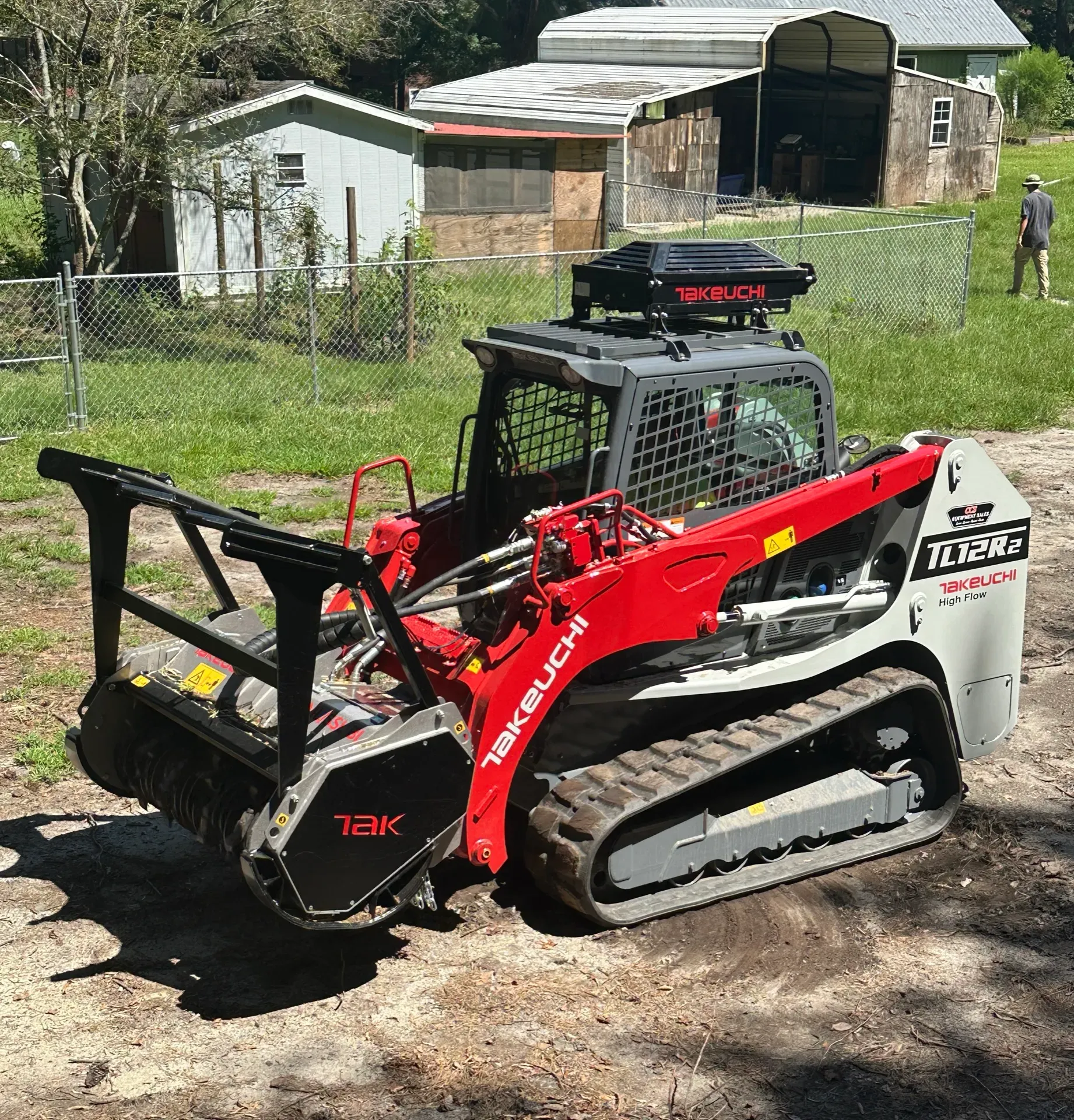
I run DC Tree Cutting and Land Service. We operate a Takeuchi TL12R2 compact track loader with a TERK mulcher head, and forestry mulching is one of the services we run most frequently across our nine-county service area in Eastern NC. I’m going to walk you through exactly what this machine does, when it’s the right call for your property, and what it’s going to cost.
Forestry mulching is simple: a heavy machine with a rotating drum covered in carbide teeth drives through standing vegetation and grinds it into mulch on the spot. Brush, saplings, small trees, vines, everything in the machine’s path gets chewed up and laid flat as a layer of wood chips on the ground. No cutting and stacking. No chipping. No hauling. No burn piles. The material goes from standing to ground cover without ever leaving your property.
That’s why it’s faster and cheaper than traditional clearing for most residential and light commercial jobs.
How the Machine Works
Our Takeuchi TL12R2 is a compact track loader - think of a small bulldozer on rubber tracks with a mulching head instead of a bucket. The TERK mulcher head bolts to the front of the machine and houses a high-speed rotating drum with fixed carbide teeth. When the operator lowers the head into the vegetation and advances, those teeth grab everything from the top down and grind it into chips.
The operator works in passes about 5 to 6 feet wide, moving systematically across the property. The mulched material gets expelled behind and beneath the machine, creating an even layer of chips on the ground. A good operator can clear roughly an acre of medium-density brush in a day, though that varies a lot based on what’s growing there.
Here’s what the mulcher handles in a single pass:
- Brush and scrub. Privet, wax myrtle, blackberry thickets, honeysuckle - all the invasive stuff that takes over neglected land in Eastern NC. The mulcher eats through it like it isn’t there.
- Saplings and small trees. Pine, sweetgum, cedar, tulip poplar, anything up to about 6 to 8 inches in diameter. The teeth grab the trunk and pull it down into the drum.
- Vines. Kudzu, poison ivy, Virginia creeper, muscadine grape. Vines are actually one of the worst things to clear by hand. The mulcher doesn’t care.
- Small stumps. Stumps under 6 inches get ground at or near grade level during the pass. Not deep enough for construction, but fine for a clean-looking property.
What’s left behind is a 2 to 4 inch layer of wood chips covering the ground. One of our customers, Willard, described the result on his quarter-acre job perfectly - he said it looked like pine bark mulch when Chris and the crew were done. That’s exactly right. It goes from an impassable tangle of brush to something that looks like a landscaped lot in less than a day.
When Forestry Mulching Is the Right Choice
I’m not going to tell you forestry mulching is the answer to everything. It isn’t. But for the right situations, there’s nothing faster or more cost-effective. Here’s where we use it the most.
Overgrown Lots and Backyards
This is our bread and butter. A homeowner bought a property with a back lot that hasn’t been touched in years. Or a landlord has a vacant parcel that’s grown up in brush and saplings. Or an estate needs to be cleaned up before it goes on the market. The vegetation is 8 to 12 feet tall, you can’t walk through it, and it looks terrible.
The mulcher turns that into a clean, walkable property in a day. We do these jobs constantly across Nash, Wayne, and Wilson counties.
Fence Line Clearing
If you own rural property in Eastern NC, you know this problem. Brush grows into and through your fence lines, and you can’t get a mower close enough to keep it back. Hand clearing is brutal, all-day work with chainsaws and loppers and still doesn’t look great.
The mulcher runs along the fence line and clears everything on your side in one pass. Done for the season. We clear fence lines for farmers throughout Greene County and Wayne County regularly.
Hunting Land Management
Hunters and hunting clubs use forestry mulching to open up shooting lanes, create food plot sites, and thin undergrowth for better visibility and movement. We do a lot of this work in Halifax, Edgecombe, and Pitt counties where there are large hunting tracts. The mulch layer left behind actually makes a good base for seeding food plots - it stabilizes the soil and adds organic matter as it decomposes.
Site Prep for Construction
For building projects on wooded lots, forestry mulching is often the smartest first step. The mulcher clears all the underbrush and small trees, giving you and your excavator operator clear sight lines to the larger timber that needs to come down. It also exposes the actual terrain so you can see drainage patterns, grade changes, and obstacles before the heavy equipment starts moving dirt.
We typically do this as a two-phase approach: mulch first, then fell large trees with chainsaws and bring in the excavator for stumps and grading. It’s more efficient than trying to clear everything with an excavator from scratch.
Pasture and Field Reclamation
Agricultural land that goes fallow grows up fast in this climate. A field that hasn’t been worked in 5 to 10 years can have substantial woody growth - sweetgum, pine saplings, cedar, all mixed in with blackberry and honeysuckle. Forestry mulching clears the woody vegetation and leaves a mulch layer that breaks down over 6 to 12 months. After that, you can disk the field and return it to production.
Right-of-Way and Utility Easements
Utility easements, access roads, pipeline corridors, ditch banks - any linear corridor that needs vegetation kept back. The mulcher is the fastest tool for reclaiming an overgrown right-of-way because it clears and processes everything in a single pass with no debris to haul.
What It Costs
Forestry mulching pricing depends on three things: how dense the vegetation is, how large the material is, and how the terrain affects machine speed.
Here’s what we typically see across Eastern NC:
- Light density (scattered brush, some saplings, mostly grass): $1,200 to $1,800 per acre
- Medium density (dense brush, saplings up to 4 inches, tangled growth): $1,800 to $2,500 per acre
- Heavy density (wall-to-wall growth, trees up to 6 to 8 inches, vines layered through everything): $2,500 to $3,500+ per acre
We have a minimum job charge of about $1,200 regardless of size. Loading the Takeuchi and mulcher head onto the trailer, driving to your property, unloading, and reversing the process at the end of the day takes the same time and fuel whether we’re mulching a quarter acre or five acres. That mobilization cost is baked into every job.
What Brings the Price Down
Good access is the biggest factor. If we can drive the Takeuchi off the trailer and straight into the work area, we’re efficient from minute one. If we have to navigate through gates, around structures, or across soft ground just to reach the vegetation, that’s time we’re spending not mulching.
Flat terrain helps. The mulcher works fastest on flat to gently rolling ground. Slopes slow the machine down because the operator has to manage traction and stability at the same time as the mulching.
Volume. A 5-acre job has a significantly lower per-acre cost than a half-acre job because the mobilization spreads across more production acres. If you have multiple lots or a large property, the per-acre number drops.
What It Costs Compared to Traditional Clearing
For light to medium vegetation - which describes most overgrown residential lots in Eastern NC - forestry mulching is almost always cheaper than traditional clearing. Traditional clearing means felling, stacking, chipping or hauling, and potentially burning. Each of those steps involves separate equipment, separate labor, and often a grapple truck to haul the debris at $900 per load.
Forestry mulching rolls all of that into one machine and one pass. No hauling costs. No dump fees. No burn permits.
Where traditional clearing can be more cost-effective is when you have large timber that has log value. If you’re clearing 20-inch oaks and pines, those logs are worth money. A traditional clearing crew can fell, buck, and sell the timber, which offsets the clearing cost. The forestry mulcher can’t process trees that size - anything over 8 inches in diameter needs to be felled with a chainsaw first.
What Forestry Mulching Won’t Do
I’d rather tell you upfront than have you find out on the job.
It won’t take down large trees. The mulcher handles up to about 6 to 8 inches in diameter. A 20-inch pine or oak needs a chainsaw and a tree removal crew. On jobs with a mix of large trees and undergrowth, we fell the big trees first and then bring in the mulcher for everything else.
It won’t remove stumps below grade. Small stumps (under 6 inches) get ground at the surface during the mulching pass. If you need stumps out for construction footings or grading, you need a stump grinder or an excavator after the mulching is done.
It won’t give you bare dirt. Forestry mulching leaves a 2 to 4 inch mulch layer on the ground. That’s actually a feature for most applications - it prevents erosion, suppresses regrowth, and looks clean. But if you need bare mineral soil for a building pad or a road base, you need traditional clearing with an excavator to follow the mulching.
It can’t work in saturated ground. Even tracked equipment has limits. If the ground is waterlogged, the machine will sink in and tear up the terrain. We’ll postpone rather than make a mess of your property. Eastern NC gets wet, especially in the lowlands along the Neuse and Tar rivers, and sometimes we have to wait for things to dry out.
What Happens to the Mulch
This is the question I get more than any other. People hear “mulching” and they think there’s going to be a 2-foot pile of wood chips sitting in their yard. That’s not what happens.
The mulcher grinds the vegetation into small chips and chunks that lay flat on the ground in a relatively uniform layer. It doesn’t look like a pile. It looks like someone spread landscaping mulch across the entire area. Over time, that mulch layer breaks down. In Eastern NC’s warm, humid climate, you’ll notice significant decomposition within 6 to 12 months. Within 2 to 3 years, most of the mulch has broken down into organic matter in the soil.
For hunting land, firebreaks, or general property maintenance, the mulch is exactly what you want. It stays and does its job. For food plots or pasture, you let the mulch settle for a few months and then disk through it. For construction, forestry mulching is the first step - you follow it with traditional clearing and grading.
The mulch layer also suppresses regrowth. Seeds that are already in the soil will still sprout, but the mulch layer makes it harder for them to establish. Mowing once or twice during the first growing season after mulching keeps most regrowth under control. Without any follow-up, you’ll see sweetgum and pine seedlings coming up through the mulch within a year, but nothing like the wall of brush that was there before.
Our Equipment
I’m specific about equipment because it matters. Not all mulching setups are equal.
Our Takeuchi TL12R2 is a compact track loader with an operating weight around 12,000 pounds. The rubber tracks distribute that weight so we don’t tear up your property the way a wheeled skid steer would. The tracks also handle slopes and soft ground better than tires, which matters on a lot of Eastern NC properties where the soil is sandy loam or clay that gets slick when wet.
The TERK mulcher head uses fixed carbide teeth on a high-speed drum. Fixed teeth are more aggressive than flail-style mulchers and handle larger diameter material. The carbide tips hold their edge longer than steel, which means consistent performance through a full day of mulching. We carry spare teeth and can swap them in the field if we hit something that causes damage.
We also run Bobcat skid steers for lighter mulching work and tight-access situations where the Takeuchi can’t fit. Between the two platforms, we can handle jobs from a quarter-acre residential lot to multi-acre rural tracts.
How to Know If Your Property Needs Mulching
Walk your property and look at what’s growing. If you can answer yes to any of these, forestry mulching is probably the right approach:
- The vegetation is too thick to walk through
- You can see saplings and small trees (not just grass and weeds)
- The growth is more than 4 to 5 feet tall and covers a significant area
- You’ve been quoted for hand clearing and the price was more than you expected
- You need to clear brush along a fence line, property boundary, or easement
- You’re prepping land for construction, food plots, or pasture and there’s woody growth to remove
If the growth is just tall grass and weeds with no woody stems, you probably need a bush hog or heavy-duty mower, not a forestry mulcher. We can point you in the right direction during the estimate.
If the property has large trees (over 8 inches in diameter) mixed in with the brush, you likely need a combination approach - tree removal for the big stuff, forestry mulching for the undergrowth. We quote these as a combined project and it’s usually more efficient than hiring two separate companies.
Getting a Free Estimate
Forestry mulching is one of those services where an on-site estimate is the only way to get an accurate price. Aerial photos and Google Earth can give us a rough idea of the scope, but we need to walk the property to assess density, diameter, terrain, and access. What looks like light brush from above can turn out to be a wall of privet and honeysuckle that’s 10 feet deep once you’re standing in front of it.
Call (252) 506-0099 (Rocky Mount) or (919) 276-0144 (Goldsboro yard) to schedule. You can also request an estimate online. We cover Nash, Edgecombe, Wilson, Wayne, Halifax, Johnston, Greene, Lenoir, and Pitt counties.
Frequently Asked Questions
How long does forestry mulching take?
It depends on the size and density. A typical residential lot (quarter to half acre) of medium-density brush takes half a day to a full day. A multi-acre rural property can take 2 to 3 days. We’ll give you a time estimate along with the price when we quote the job.
Is forestry mulching loud?
Yes. The mulcher head spinning at high RPM processing wood is loud. We wear hearing protection. If you have neighbors close by, expect construction-level noise during the work. It’s not something that runs all week - most residential jobs are done in a day.
Can you mulch right up to my fence or structure?
We can get close, but the mulcher head has a fixed width and the operator needs clearance to maneuver. We typically leave 2 to 3 feet from fences and structures and hand-clear the remaining strip if needed. We’re careful around fences because a mulcher will destroy a wire fence if it catches it.
Will the mulcher damage my property?
The tracked undercarriage is much gentler than wheeled equipment, but it will leave track marks on soft ground or manicured lawn. We minimize turf damage by staying on the work area and using the most efficient path in and out. If you have irrigation lines, underground utilities, or septic components in the work area, tell us before we start.
Do you do forestry mulching year-round?
We mulch year-round as long as ground conditions allow. Winter is actually a great time for mulching because the ground is firmer (less rain), snakes are dormant, and there’s less leaf canopy obscuring the operator’s view of the terrain. Spring and summer are busiest because that’s when property owners notice how much their overgrown lots have exploded.
What’s the difference between forestry mulching and bush hogging?
A bush hog is a rotary mower pulled behind a tractor. It cuts grass and light brush at ground level, like a heavy-duty lawn mower. It cannot handle saplings, small trees, or dense woody growth. Forestry mulching uses a dedicated mulcher head that grinds standing woody vegetation into chips. If your property has trees and brush, you need a mulcher. If it’s just tall grass and weeds, a bush hog will do.